
Yes, Zilla, I do know the name of the butterfly. It is a Painted Lady, Vanessa cardui.
Of course, I didn't know when you asked me, but I have garnered quite a collection of online resources in my 12 years as mother of children who ask nothing but questions. Look at this wonderful UGA site. I needed other pictures to make the identification, but I just happened to have them, since Princess was trying to capture her image for the Neshoba County Fair Photography Competition and took about 50 images of that butterfly and zinnia. She wasn't pleased with any of them. See why I need so many extra external hard drives.
Once you finish identifying butterflies, you can also identify birds, frogs, lizards, turtles, insects, plants, and fungi. I would have to say that it is a most useful site for my questioning, nature children.
Showing posts with label school. Show all posts
Showing posts with label school. Show all posts
Friday, June 20, 2008


Monday, May 14, 2007
Spiraling
I know I haven't written much about school lately. For some reason, maybe because it is going well right now, I am not planning for the future or lamenting the failures. I suppose I should document the progress and try to recreate the balance for next year. Anyway, formal school is spiraling to the finish line. Princess finished all planned work in math Friday. Pink Panther will finish his planned math work this week. Grammar, handwriting, Latin, and spelling will finish this week, as well.
Unfortunately, I was so ambitious in the planning of Ancient History that we may not finish this summer. The World in Ancient Times series has taken us on a well informed journey that won't be finished soon. We will start Ancient Rome today. Did you catch that s word? I did say start. After Rome there is one more book in the series. Ouch. The children have never associated history with "real school," so perhaps continuing will be a continuation of story time?.
At Christmas I started looking through the spine of our history reading to see if there was anything I could neglect to read. I haven't found anything that doesn't seem interesting or important, so I just keep reading and they just keep listening and narrating. I wonder. Is this one of those Charlotte Mason good habits?
Spiraling to the beginning of the Middle Ages, I wonder if they would notice if we didn't take a summer break in history?
Unfortunately, I was so ambitious in the planning of Ancient History that we may not finish this summer. The World in Ancient Times series has taken us on a well informed journey that won't be finished soon. We will start Ancient Rome today. Did you catch that s word? I did say start. After Rome there is one more book in the series. Ouch. The children have never associated history with "real school," so perhaps continuing will be a continuation of story time?.
At Christmas I started looking through the spine of our history reading to see if there was anything I could neglect to read. I haven't found anything that doesn't seem interesting or important, so I just keep reading and they just keep listening and narrating. I wonder. Is this one of those Charlotte Mason good habits?
Spiraling to the beginning of the Middle Ages, I wonder if they would notice if we didn't take a summer break in history?
Sunday, May 13, 2007
If you are planning Early American History
There is a wonderful article by Charles Mann in the May National Geographic that gives a believable account of the the settling of Jamestown including a cool map. At their website they have an interactive map and other interesting stuff. Charles Mann wrote 1491: New Revelations of the Americas Before Columbus. I will have to add this one to my list along with the children's book, 1607: A New Look at Jamestown, written by another contributor to the article, Karen Lange.
I'll be getting back to my magazine before someone sneaks it.
Oh! One more thing, my precious bees are an invasive species. I've never thought of them like that. Isn't it interesting that a non-native insect has dominated life as we know it and its possible demise is causing tremors of fear across America?
I'll be getting back to my magazine before someone sneaks it.
Oh! One more thing, my precious bees are an invasive species. I've never thought of them like that. Isn't it interesting that a non-native insect has dominated life as we know it and its possible demise is causing tremors of fear across America?
Friday, April 06, 2007
Struggling with Day Light Savings Time
I doubt that the powers that be gave two seconds thought to the by-products of an earlier Day Light Savings Time. In fact, I never thought of consequences. Being the energy conserving maniac that I am, I was excited! Now, I've changed my mind. Every night I struggle to keep a school schedule for bed-time rituals. Yet, the children play longer; we start supper later; we eat later; we go to sleep later. The children wake up later. Starting school before 8:30 (which is our goal) is impossible for children who don't get to sleep until 10 something.
Knowing the struggle of morning, I concentrate more on an early start. Yet, I am affected by the light. I am weak. I want to play longer outside. I want to leisurely prepare dinner. I don't want to sacrifice our reading time.
Since this is Poetry Friday for many of my online friends, I thought I would share a fitting poem by Robert Louis Stevenson. I hope y'all don't mind me playing along.
Knowing the struggle of morning, I concentrate more on an early start. Yet, I am affected by the light. I am weak. I want to play longer outside. I want to leisurely prepare dinner. I don't want to sacrifice our reading time.
Since this is Poetry Friday for many of my online friends, I thought I would share a fitting poem by Robert Louis Stevenson. I hope y'all don't mind me playing along.
Bed in SummerHonestly, I am so happy my children don't have a school bus to catch.
In winter I get up at night
And dress by yellow candlelight.
In summer, quite the other way,
I have to go to bed by day.
I have to go to bed and see
The birds still hopping on the tree,
Or hear the grown-up people's feet
Still going past me in the street.
And does it not seem hard to you,
When all the sky is clear and blue,
And I should like so much to play,
To have to go to bed by day?
Saturday, March 17, 2007
The Birchbark House
On the drive to and from the beach we listened to Louise Erdrich's The Birchbark House. I chose it because Susan at Chicken Spaghetti was going to read it with her child. I had not heard of this book, so I investigated and thought it would be a good match for our family. I couldn't get a copy of the book without special ordering, so I downloaded the book for my iPod.
The children and I loved the tale of Frog, the Anishinabe/Ojibwe girl, who is comparable to Laura of Little House fame. We listened to tales of her mischief, her courage, and grief. We learned much.
Now, though we are studying ancient history, we will have to take a side trip to the Northern Great Lakes area to satiate the children's desire for more information. I found this interesting web site. It has lesson plans (which I won't use) and much great information.
Thanks, Susan!
Oops I forgot: The reader, Nicolle Littrell, was great. She did voices and animal sounds.
The children and I loved the tale of Frog, the Anishinabe/Ojibwe girl, who is comparable to Laura of Little House fame. We listened to tales of her mischief, her courage, and grief. We learned much.
Now, though we are studying ancient history, we will have to take a side trip to the Northern Great Lakes area to satiate the children's desire for more information. I found this interesting web site. It has lesson plans (which I won't use) and much great information.
Thanks, Susan!
Oops I forgot: The reader, Nicolle Littrell, was great. She did voices and animal sounds.
Wednesday, February 28, 2007
Ecce Romani
Don't faint! because I am doing a homeschooling post. I know it has been a long time.
Warning: I am a complete foreign language imbecile. I once had a teacher tell me to "Give it up! With your lazy tongue you will never be able to do anything more than drawl."
But I keep trying. . . For two years we used Latin Primer, but at Christmas we moved to the story based Ecce Romani. Pink Panther and I learned a good bit of Latin with the Latin Primer Program. We still review many of the chants and vocabulary, but we needed a boost in excitement, so I researched and found this story based program. We love it!!!! With mischievous boys and servants who yell "Abite, molesti!"(Go away you pests!), daring rescues, and everyday life captured in accessible Latin, we have been enjoying Latin rather than tolerating it. I purchased the workbook and audio CDs since I had no prior (before homeschooling) Latin knowledge.
The CD reads the story, reads the story with pauses (so you can repeat the sentences), and reviews vocabulary. We listen and repeat this every day of the week, then work on a few of the exercises. By doing only one chapter a week we get to spend plenty of time with the exercises and practice, while still maintaining our Charlotte Mason inspired short lessons.
You can get the entire program from Pearson Educational. They have a special homeschool registration, but then you have access to all of the Pearson Educational materials.
I just overheard my 7 year old daughter yell, "Abite molesti!" to my son and husband as they were chasing her around the house. I think we have a keeper.
Warning: I am a complete foreign language imbecile. I once had a teacher tell me to "Give it up! With your lazy tongue you will never be able to do anything more than drawl."
But I keep trying. . . For two years we used Latin Primer, but at Christmas we moved to the story based Ecce Romani. Pink Panther and I learned a good bit of Latin with the Latin Primer Program. We still review many of the chants and vocabulary, but we needed a boost in excitement, so I researched and found this story based program. We love it!!!! With mischievous boys and servants who yell "Abite, molesti!"(Go away you pests!), daring rescues, and everyday life captured in accessible Latin, we have been enjoying Latin rather than tolerating it. I purchased the workbook and audio CDs since I had no prior (before homeschooling) Latin knowledge.
The CD reads the story, reads the story with pauses (so you can repeat the sentences), and reviews vocabulary. We listen and repeat this every day of the week, then work on a few of the exercises. By doing only one chapter a week we get to spend plenty of time with the exercises and practice, while still maintaining our Charlotte Mason inspired short lessons.
You can get the entire program from Pearson Educational. They have a special homeschool registration, but then you have access to all of the Pearson Educational materials.
I just overheard my 7 year old daughter yell, "Abite molesti!" to my son and husband as they were chasing her around the house. I think we have a keeper.
Friday, January 26, 2007
I'm Sorry
I realize I have inadvertently sent those of you with news feeds back into the archives because I am getting comments on an old post from last March. I was trying to repair the messy code that sends the table on the Math Facts entry to the bottom. For my book post, I got the table to hover where it should, so I thought I would go back and fix the old post because I am weird that way. I didn't realize that every time I edited an entry a flag would be sent up. Sorry. I will try to control myself in the future.
While we are on the subject of math let me share what I have learned since March. There is another option in the math music genre: The Googols. We love the Multiplication CD that I downloaded from iTunes to my iPod so we can listen to it anywhere. Sample Seven Natural Wonders and Yodel-Odel-Eight from iTunes. True, the tunes are not just about multiplication, but who cares. They are addictive. We have not tried any of the other activities at the Googol Power site but love the well done Multiplication Vacation.
I also found that with my "math is misery child" I should nurture while maintaining the standards. Letting him do less because it was painful to me only reaffirmed his poor self concept in math. By sticking with the problem areas, in small doses, until they were mastered let him know he could be successful if he gave himself the opportunity. We did switch from Saxon for a while and used these ebooks and Modern Curriculum Press Mathematics, yet I find that the Saxon daily review is useful, so I add a little diversity to each day so nothing is forgotten. Mostly, I just quit panicking.
While we are on the subject of math let me share what I have learned since March. There is another option in the math music genre: The Googols. We love the Multiplication CD that I downloaded from iTunes to my iPod so we can listen to it anywhere. Sample Seven Natural Wonders and Yodel-Odel-Eight from iTunes. True, the tunes are not just about multiplication, but who cares. They are addictive. We have not tried any of the other activities at the Googol Power site but love the well done Multiplication Vacation.
I also found that with my "math is misery child" I should nurture while maintaining the standards. Letting him do less because it was painful to me only reaffirmed his poor self concept in math. By sticking with the problem areas, in small doses, until they were mastered let him know he could be successful if he gave himself the opportunity. We did switch from Saxon for a while and used these ebooks and Modern Curriculum Press Mathematics, yet I find that the Saxon daily review is useful, so I add a little diversity to each day so nothing is forgotten. Mostly, I just quit panicking.
Tuesday, January 23, 2007
Papyrus Paper
Remember my weekend post about the benefits of a cluttered office or home. Manufacturing of papyrus paper has been one of the causes of the clutter, recently. We have made recycled paper on several occasions and when I saw these kits in the Rainbow Resource catalog, I thought it would be a fun, though not taxing, addition to our Ancient Egypt study. In reality we have had papyrus pulp soaking in the kitchen for a couple of weeks. We didn't just have one container either; we had two so each child could have his own project.
Making papyrus paper goes something like this.
See what wonderful things can happen if you are open to a bit of clutter.
Next, we will experiment with smut ink and hieroglyphics. I hope the paper is usable.
Making papyrus paper goes something like this.
- They soak the pulp while sloshing sticky papyrus water all over the counters while they are watching the progress,
- They roll with my nice rolling pin while I wonder whether the rolling pin will be fit for pastry after its tour of paper making with my over zealous children
- They slosh water all over the floor as they transport old water to the sink and refill for the next round of soaking,
- They soak for another 3 days while asking me, "Is it ready yet?"
- They roll the papyrus pulp more vigorously this round, splashing water all over the kitchen as the rolling pin presses absorbed water out of the papyrus,
- They slosh water out of the trays onto the floor as they get fresh water,
- They soak, again,
- Then, using about 10 dish cloths per child they lay out the fibers in a criss cross pattern overlapping each piece, press the papyrus between 2 dish cloths until all moisture is absorbed using my nice rolling pin, and flatten the "paper" as much as possible,
- Then they transfer "paper" to some newspaper sections and weight it with stacks of books which I had in abundance since I didn't "organize and clean" this weekend. They didn't even have to leave the kitchen to gather enough weight
- Finally, they continue to switch out the newspaper until the "paper" is dry and paper like.
See what wonderful things can happen if you are open to a bit of clutter.
Next, we will experiment with smut ink and hieroglyphics. I hope the paper is usable.
Monday, January 01, 2007
A Broader View
As I teach my children at home using materials that are essentially derived from a classical approach to education, I find that I must be ever vigilant that our readings don't narrow our perspective rather than broaden it. With traditional suggested readings for our grade levels, the world view is presented in a typically Euro-male perspective. I have chosen to use classic books in our homeschool because I want to give my children the information they need to make connections, see allusions, and join the Great Conversation. As much as I believe in the importance of the Classics, I know that we cannot stop there. Our world is smaller because of technology and mobility. We need to know the other stories, as well as our own, to interact productively in the world.
Let me give you an example. The first day of my first year of teaching (outside the home) I walked into a classroom and looked around and saw twenty five students, no two of which had a similar skin tone. I asked the first question that came to my mind, "How many of you speak another language other than English at home?" Twenty of the twenty five students raised their hands. There were eighteen different first languages in that class and so began my education. Struggling with ESL issues in writing was the more manageable problem that year. The larger problems arose from dealing with assumptions we all make based on our traditions, views of history, religion, and other prior knowledge.
I found that you could not assume that history is perceived in a chronological way with important dates marking the way. I found that courtesy in discussion could be enforced but ingrained hatred - hatred of which I have no experience does exist and is taught from birth - cannot be overcome in a semester. I found that I could not expect girls from some cultures to take a stand against a man even if it was just in a class and just about literature. The reality of leading a class of so diverse a population was that I could assume nothing and I had a lot to learn. I never had another class that culturally diverse, but the lessons I learned that year and in subsequent years have never left me. The literature, history, theology, and anthropology I studied to bring understanding is not necessarily appropriate for young children, but I do attempt to add culturally diverse reality to our classical home studies with other resources.
Jokes run rampant about the attempts of government, schools, and individuals to become "Politically Correct." Political correctness is not what I wish to teach my children. What I seek to do is to show my children that what we believe to be written in stone based on our traditions is water writing in other cultures. I want to teach true respect for individuals. Teaching true respect comes from modeling the behavior yourself, but I also find it helpful to introduce literature, art, cultural study, and religion of different peoples without reducing the studies to stereotypes.
Here are a few suggestions:
While true respect for individuals and their beliefs can never be taught in school, an understanding of those beliefs, an appreciation of the contributions of the various peoples, and an insight into the realities of other cultures, which don't include stereotypes, can only serve to open a dialog between peoples that will lead to greater understanding and acceptance of the differences and similarities of people in our multi-cultural world.
Let me give you an example. The first day of my first year of teaching (outside the home) I walked into a classroom and looked around and saw twenty five students, no two of which had a similar skin tone. I asked the first question that came to my mind, "How many of you speak another language other than English at home?" Twenty of the twenty five students raised their hands. There were eighteen different first languages in that class and so began my education. Struggling with ESL issues in writing was the more manageable problem that year. The larger problems arose from dealing with assumptions we all make based on our traditions, views of history, religion, and other prior knowledge.
I found that you could not assume that history is perceived in a chronological way with important dates marking the way. I found that courtesy in discussion could be enforced but ingrained hatred - hatred of which I have no experience does exist and is taught from birth - cannot be overcome in a semester. I found that I could not expect girls from some cultures to take a stand against a man even if it was just in a class and just about literature. The reality of leading a class of so diverse a population was that I could assume nothing and I had a lot to learn. I never had another class that culturally diverse, but the lessons I learned that year and in subsequent years have never left me. The literature, history, theology, and anthropology I studied to bring understanding is not necessarily appropriate for young children, but I do attempt to add culturally diverse reality to our classical home studies with other resources.
Jokes run rampant about the attempts of government, schools, and individuals to become "Politically Correct." Political correctness is not what I wish to teach my children. What I seek to do is to show my children that what we believe to be written in stone based on our traditions is water writing in other cultures. I want to teach true respect for individuals. Teaching true respect comes from modeling the behavior yourself, but I also find it helpful to introduce literature, art, cultural study, and religion of different peoples without reducing the studies to stereotypes.
Here are a few suggestions:
- Geographical study - By knowing the terrain, political boundaries, and seasons much can be understood about the development of cultures. If flood and drought periods dictate the lives of a people, then culture and religion will be established based on the cyclical nature of their lives. If mountains, swamps, or deserts isolate a group for long periods of time, those cultures will have developed based on those restrictions. Geography is essential to understanding.
- Religion - Religion, in many ways, defines a culture and the actions of the peoples. By studying world religions we can gain a greater understanding and respect for the people practicing those religions. We have used The Usbourne Book of World Religions for a base study and have enjoyed the concise explanations of the basics of the six major religions. Mentions of subgroups are included, but defining differences are not necessarily given. This book is a good starting place and enough information for young children.
- Literature - I believe that much can be learned about people through reading literature. In fiction you get insight into daily routines, religious practice, and social traditions that is more informative than fact lists because you are privy to the emotion and the conflict. Finding appropriate material for young children is not difficult.
If you are reading about India do a library search for that area and narrow the search by eliminating adult material and non fiction. I prefer stories written by a member of the cultural group that have been translated or folk tales that may have several versions.- In a Circle Long Ago by Nancy Van Laan is a compilation of Native American Lore.
- Only Passing Through: The Story of Sojourner Truth by Anne Rockwell is a picture book that combines the reality of African American Art and the story of Sojourner Truth.
- Gay-Neck: The Story of a Pigeon by Dhan Gopal Mukerji is a pigeon story but also a story that gives great insight into the life of a boy in India.
- The Cinderella stories - Variations of the Cinderella stories have amused and challenged my children. We have read ten or more. Side by side comparisons are wonderful for highlighting differences. There are several Internet sites with information on Cinderella story variations. I think this one is the most straightforward and informative.
- The House on Mango Street by Sandra Cisneros is a wonderful verbal picture of Mexican American life. Be forewarned, while the reading level and vignette format makes the book accessible for younger readers some of the content is more adult. Pick and choose stories.
- Poetry - is a great way to introduce varying cultures. Think of the power of Langston Hughes poetry and the stark beauty and sparseness of haiku and other Japanese poetry.
- The Asante and Native American Trickster Tales in which animals teach the lessons that are important to be passed along.
- Art - Looking at the art of various cultures can illustrate the stories without words, what materials are available, and which things are sacred or of high importance. The quilts of Faith Ringgold, Choctaw baskets and needlework, Guatemalan textiles, origami, African drums, masks, and Kente cloth, Inuit carving, and Japanese gardens are just a few.
- Music - Listening to and appreciating music of various cultures can be more challenging because of language barriers, but experiencing the tabla of India, the various African drums, the Latin rhythms, and the energy of the polka can open communication.
While true respect for individuals and their beliefs can never be taught in school, an understanding of those beliefs, an appreciation of the contributions of the various peoples, and an insight into the realities of other cultures, which don't include stereotypes, can only serve to open a dialog between peoples that will lead to greater understanding and acceptance of the differences and similarities of people in our multi-cultural world.
Monday, November 06, 2006
Time line
I worked on my timeline solution this weekend. Of course, it did not turn out exactly as I imagined, but I did get to use the Timeliner software and I have timeline pages for the children to use for narrations, illustration, self-expression. I divided the ancient timeline into really ancient (5,500,000 BCE to 4,500 BCE) and ancient. I entered all the timeline dates from The World in Ancient Times Series, color coded by area (Mesopotamia, South Asia, Egypt, Greece, Rome, America, Chinese) . There are some pages that have almost too much information on them and then there are pages with no documented history. The children will have fun finding something to go there. I, like Jove, prefer to let the children explore and bring information to table. They are old enough to start seeking within the structure of the base timeline. What is another word for timeline? I know I have used it 20 times already.
I have printed the timeline pages on card stock and will trim (because I am obsessive compulsive) and tape the edges so the pages can be spread and studied. I am so excited!!!!
Take a look at the Ancient and the Really Ancient and Earliest Clues. I have repaired the links (I really did this time), but dial-ups should still be warned. The first file is over over 1 MB, but the others are relatively small.
I have printed the timeline pages on card stock and will trim (because I am obsessive compulsive) and tape the edges so the pages can be spread and studied. I am so excited!!!!
Take a look at the Ancient and the Really Ancient and Earliest Clues. I have repaired the links (I really did this time), but dial-ups should still be warned. The first file is over over 1 MB, but the others are relatively small.
Friday, November 03, 2006
Timeline malfunction
A few months ago, I made the decision to use Timeliner, a fancy computer time line tool, with our history study. Committed to the computerized time line, I made the entries for the first two books of The World in Ancient Times series. The children showed only limited interest in finding clip art, websites, and other information to use in the timeline. The reality and fun of making their own pages for a hands-on book far outweighs the cool timeline slideshows and interactivity of the Timeliner timeline. On another note, I am disappointed that I am not able to stop the timeline where I want it. I only want to work with ancient history this year and once I enter a few ancient dates the timeline defaults to a geologic timeline that represents 5,500,000 years ago to the present which would be fine if I had unlimited expansion so that when lots of documented action begins the entries aren't so crowded. I don't mind the umpteen blank pages so I feel the program should allow me to spread it out as far as I want. It doesn't.
I'm frustrated because the program, though great, is not working for us and if I scrap it, we will be forced to stop history and go back to redocument our progress. If I don't stop using it, I will be responsible making timeline entries with only marginal interest from the children. I could just start from where we are, but I want them to have a complete record of the four year history cycle.
I will be making time line pages for the children this weekend, unless someone has already done this and would be willing to share. ?????
I'm frustrated because the program, though great, is not working for us and if I scrap it, we will be forced to stop history and go back to redocument our progress. If I don't stop using it, I will be responsible making timeline entries with only marginal interest from the children. I could just start from where we are, but I want them to have a complete record of the four year history cycle.
I will be making time line pages for the children this weekend, unless someone has already done this and would be willing to share. ?????
Wednesday, October 25, 2006
I promise we are schooling!
I know I have not written a thing about our homeschool in soooo long, but we are progressing nicely. In fact, I have amazed myself with my consistency this year. In past years, if the children complained, whined, or told me they were bored, I immediately withdrew. This year I am immune to whining, will listen to complaints only if they are based on legitimate concerns, and process laments of boredom within a week. I have found that if the children know they are going to do the basics every single day they will not waste their time whining, complaining, or telling me I am boring.
Consistency can be boring, but it can also be rewarding. Spelling is improving dramatically and math concepts are being mastered. The children are learning that a little discomfort and boredom today will be exchanged for a vast store of knowledge and skill that will work for them later. Yes, I attempt to actively engage my children with exciting projects, experiments, and hands on learning, but I have stopped trying to make all learning a game. Some things just have to be memorized.
I realize there is a balance to be obtained, so I am actively pursuing a balance of fun and games and serious "get it done" study.
Consistency can be boring, but it can also be rewarding. Spelling is improving dramatically and math concepts are being mastered. The children are learning that a little discomfort and boredom today will be exchanged for a vast store of knowledge and skill that will work for them later. Yes, I attempt to actively engage my children with exciting projects, experiments, and hands on learning, but I have stopped trying to make all learning a game. Some things just have to be memorized.
I realize there is a balance to be obtained, so I am actively pursuing a balance of fun and games and serious "get it done" study.
Wednesday, October 18, 2006
Wonderful resources that can't wait until
I can think of something wonderful to say. This is unbelievable - a searchable online Charles Darwin complete with pictures. Sometimes, I am completely blown away by the wonderful resources on the internet. Usually, I am astounded by the junk, but today, I bow to the people who worked so hard to make an almost complete works of Darwin available online for free!!
Wednesday, October 04, 2006
Ancient History Revisited
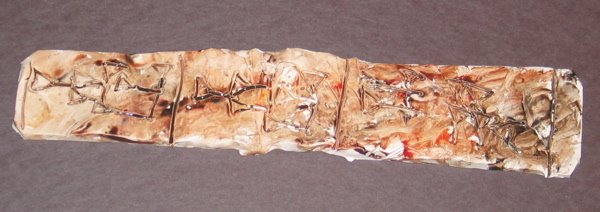 We are still working our way through The World in Ancient Times series by Oxford Press. Having finished Early Human World, we have moved to The Ancient Near Eastern World. The study of Mesopotamians as they begin to communicate through writing with their clay tokens and envelops, progressing to pictograms, and cuneiform is fascinating. We are using Sculpey for our recreations since it is much less messy than our natural clay. The clay tablet above has Pink Panther's monogram in cuneiform. Write like a Babylonian is a website that will convert your name and initials into a cuneiform monogram. The children then copied their monogram into clay and baked (and since our clay was sculpey, painted). The children found out that the seemingly simple cuneiform is more difficult to produce than it looks, and erasing on clay is easy but not precise.
I've learned many things too. First, I owe Henry Cate an apology. When he responded, in one of my planning entries, that he and his children started reading the Old Testament last year and were now in Kings, I thought (thank goodness I didn't open my big mouth) "They must be piddling around, only 10 books in a year." After two months, we are just finishing Genesis. I am sorry, Henry. I have learned that The Old Testament is dense and if we make it to Kings by next year we will be accomplishing something remarkable.
I have also learned that ancient literature is not devoid of the sexually explicit language and images that we so lament in television and advertisements of today. All literature, including The Old Testament (even if you have read it and think you know it) should be previewed to prepare you for edits or the questions that arise. The Old Testament is replete with incest, giving of slaves for pleasure or reproduction, murder, and surprising intrigue. The unabridged Gilgamesh, which I chose as a audio book for our ballet trips, has at least one "Oops!" section in which I was frantically looking for the mute button. Both of these books, I had read as an adult but not as a parent/educator of young children. There is a difference.
All in all, though we have not gotten to the more popular Ancient Greeks, Romans, Chinese, and Egyptians we are having a great time in history.
Friday, September 08, 2006
It's been like Christmas around here!
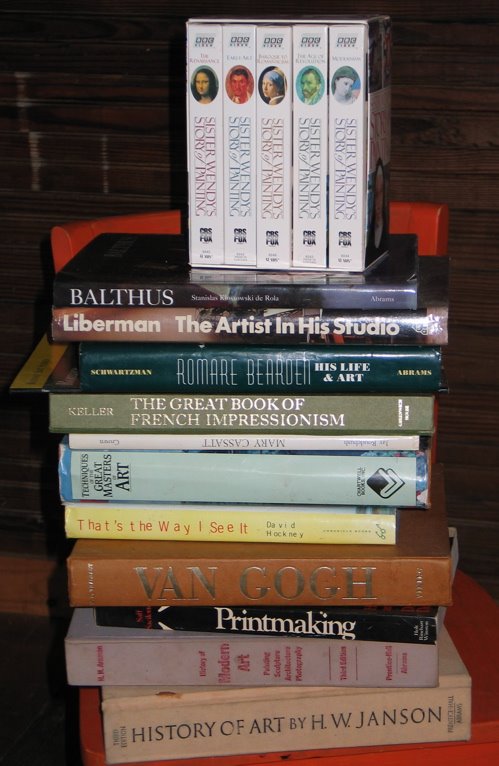
Yesterday, a friend called and said, "I know you are purging, but I thought you might like some art books for your homeschool." I knew they would be good because she was an art major in college. I, of course, said I was interested because I never met a book I didn't like. A picture would be great, but unfortunately I have not been able to post a picture in days - you know one of those beta blogger oops. What was I thinking when I clicked migrate? Where was I? There are books on Van Gogh, Cassatt, Balthus, and Romare Bearden. There is a book called The Artist in His Studio and one called That's the Way I See It. Videos of the Sister Wendy Beckett series The Story of Painting are also included. I think there are twelve nice art books, hardcover with lots of pictures.
The best thing about the gift is that gifts from this friend don't come with a lot of strings. I can accept the gift, then regift them any time - including tomorrow. She won't come snooping to see if we are using the books every day for six years.
Thursday, September 07, 2006
Rethinking Math
My son only enjoyed Math while all aspects of the proceedings included tangible items - fish counters, cuisenaire rods, number boards - and no pencil. Even though he does an incredible job at mental math and seeing patterns, he loathes math. Just the mention of the subject produces a facial expression that would send any sensitive hearted mother to tears. We have been using Saxon Math all these years. I liked the manipulative approach and the "meeting." We made it through the first three years, not easily. Saxon 5/4, which we used last year, lost the manipulative approach and used a pencil profusely to copy problems, etc. I worried daily that I would be the receiver of the "black spot (Treasure Island)." Math shouldn't be that painful. In fact, it could be great fun.
The first weeks of school we did some fun cuisenaire math puzzles and practiced some math facts. My son enjoyed these weeks, but as soon as the Saxon text appeared on the kitchen table, I lost him. I tried to get him interested, to no avail.
I e-mailed Mother Crone and sought her help which was a very smart move. She had abandoned Saxon Math years before and had some good ideas and, more importantly, support and kind words. I felt guilty that I had waited so long (until near crisis) to make a change. Homeschooling gives you the option to change direction and rethink any time resources are not working. So, why was I so stuck on this one program? Why did I insist that math needed to be endured? Why didn't I trust my son?
It will take me a while to do all the proper investigation to rethink an entire year of math and get new resources. While investigating some of Mother Crone's suggestions, I found and purchased a few ebooks that will get us through until more permanent decisions are made. Funny, the author, once responded to one of my entries lamenting teaching math. If I had listened, I could have saved months of torture for my son and for me. The ebooks appear clear, use sound math logic, and have plenty of practice, but not mind numbing quantities. Even better, you only have to print the pages you intend to use which saves tons of paper. Even though there are many typos (which drives me insane), I feel that these ebooks are a bargain.
Just losing the signal for misery (Saxon text) has made all the difference.
The first weeks of school we did some fun cuisenaire math puzzles and practiced some math facts. My son enjoyed these weeks, but as soon as the Saxon text appeared on the kitchen table, I lost him. I tried to get him interested, to no avail.
I e-mailed Mother Crone and sought her help which was a very smart move. She had abandoned Saxon Math years before and had some good ideas and, more importantly, support and kind words. I felt guilty that I had waited so long (until near crisis) to make a change. Homeschooling gives you the option to change direction and rethink any time resources are not working. So, why was I so stuck on this one program? Why did I insist that math needed to be endured? Why didn't I trust my son?
It will take me a while to do all the proper investigation to rethink an entire year of math and get new resources. While investigating some of Mother Crone's suggestions, I found and purchased a few ebooks that will get us through until more permanent decisions are made. Funny, the author, once responded to one of my entries lamenting teaching math. If I had listened, I could have saved months of torture for my son and for me. The ebooks appear clear, use sound math logic, and have plenty of practice, but not mind numbing quantities. Even better, you only have to print the pages you intend to use which saves tons of paper. Even though there are many typos (which drives me insane), I feel that these ebooks are a bargain.
Just losing the signal for misery (Saxon text) has made all the difference.
Tuesday, August 29, 2006
Having fun in History
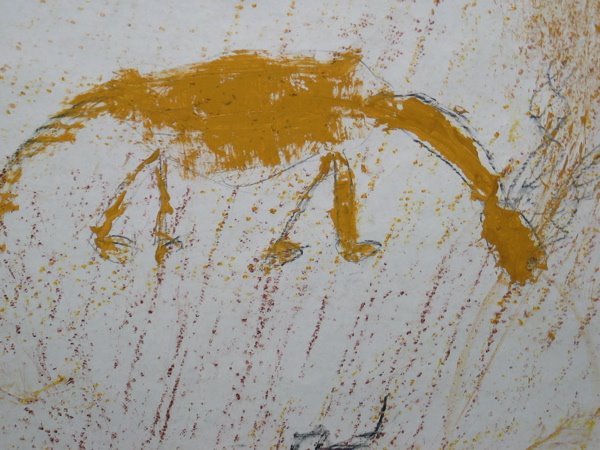 I think I have mentioned earlier that our home school is using The World in Ancient Times series published by Oxford for our history reading. We are loving the stories about archaeologists, anthropologists, and paleontologists in the first book, The Early Human World, who are making discoveries and attempting to place the pieces of our past. Yesterday, we read about Jean-Marie Chauvet, Christian Hillaire, and Eliette Deschamps finding cave art in December of 1994. The thrill of making a discovery and the significance of the art in the research of our past is documented in just enough detail for the children. Though the book has some great pictures, we took it a step further and looked at more pictures in Sister Wendy Beckett's The Story of Painting and the really cool website of the Cave of Chauvet-Pont-D'Arc.
 Take the tour!!
We, next, tried a cave art project from Art Smart by Susan Rodriguez. The children went outside and gathered sticks, dried grasses, bits of charcoal, and some roots to use as brushes. We then took butcher paper and placed it onto the concrete patio and texturized it with brown and tan crayons. After the paper was transformed into a cave wall, we hung it in the dog trot and Princess and Pink Panther started drawing animals and hands. They both commented that using the found tools was much more difficult and if they had it to do over again, they would know which things would make better tools and could do a better job.
I was excited because all the elements - books, art project, Internet site - came together to create something tangible, something fun, something they will remember. My husband came home and said that if it were darker he would have thought he was in a cave. That was just enough encouragement for the children to add more paper and art to the hallway. As long as I don't trip on the skull of a cave bear (or any other creature for that matter), let the transformations begin.
Thursday, August 17, 2006
I've been Napping
After organized school time, after I uploaded a batch of updates for a web site, after I went to the office to muddle with a networking problem, and after I picked up one or two things from the grocery store, I took a nap. I just couldn't go any longer. The heat and humidity are debilitating. I believe the heat index is hovering around 105, though the temperature is 96. I find it difficult to find the energy to do much of anything outside or, apparently, inside.
Regardless of the heat, or perhaps because of it, school has been going well. This is the best year ever. I have relaxed. I have begun to trust myself to know what my children need to know. I have become attuned to their educational needs so I can help them learn the things they want to know. We are all learning, happily. An example of this new found confidence lies in the grammar program.
We started The Plan this week by easing in with a review of subject, verb, noun and predicate definitions. My children know these so there was no problem here. I do want to mention the really cool way Strunk and White define a verb, "Verbs activate sentences." Yes, they also have the more standard show action or state of being in the definition, but they finish with, "Verbs activate sentences." I just love that simplicity.
We moved forward by identifying and diagramming subjects and verbs in simple sentences. I took the sentences straight from Henry and Ribsy, one of the books The Pink Panther is reading. I think taking the sentences from real texts or their own writing is important because the child makes the connection between language in books and what goes on in grammar. And that makes grammar more important. Some of you may be saying, "Why is she making her children diagram sentences? No one does that any more." I say diagraming is just a tool to help understand how sentences are formed. Besides, I think it is fun in small doses. Apparently my children do, too. Now if you need help remembering (or learning) those diagraming systems, there are several workbooks and books with diagramming. Of course, the first thing you need to do is decide how you will spell the word so you can do an internet search. Is it diagramming or diagraming? Both are acceptable and both are used in titles of books about the subject. Here are a few I have seen:
After the diagramming, I added some editing practice. For this I do use a workbook type thing because no one wants their errors highlighted when they are just learning to put it all together. I chose Editor in Chief from Critical Thinking. Princess is not participating in this, yet, though I do hope she will be able to hop aboard fairly soon.
Added to this the children are reading good books, writing in a journal, and studying spelling. I will ask for more of them as they progress. That's grammar!
Regardless of the heat, or perhaps because of it, school has been going well. This is the best year ever. I have relaxed. I have begun to trust myself to know what my children need to know. I have become attuned to their educational needs so I can help them learn the things they want to know. We are all learning, happily. An example of this new found confidence lies in the grammar program.
We started The Plan this week by easing in with a review of subject, verb, noun and predicate definitions. My children know these so there was no problem here. I do want to mention the really cool way Strunk and White define a verb, "Verbs activate sentences." Yes, they also have the more standard show action or state of being in the definition, but they finish with, "Verbs activate sentences." I just love that simplicity.
We moved forward by identifying and diagramming subjects and verbs in simple sentences. I took the sentences straight from Henry and Ribsy, one of the books The Pink Panther is reading. I think taking the sentences from real texts or their own writing is important because the child makes the connection between language in books and what goes on in grammar. And that makes grammar more important. Some of you may be saying, "Why is she making her children diagram sentences? No one does that any more." I say diagraming is just a tool to help understand how sentences are formed. Besides, I think it is fun in small doses. Apparently my children do, too. Now if you need help remembering (or learning) those diagraming systems, there are several workbooks and books with diagramming. Of course, the first thing you need to do is decide how you will spell the word so you can do an internet search. Is it diagramming or diagraming? Both are acceptable and both are used in titles of books about the subject. Here are a few I have seen:
- Better Sentence Structure through Diagraming comes in two levels and provides straightforward instructions and exercises. The lines are drawn and the students fill in the blanks. You can get this at Rainbow Resource.
- Diagraming Sentences is also a workbook (around $6) but this one has perforated pages. The student is required to draw the lines rather than construct sentences to fit the diagram.
- Grammar by Diagram by Cindy Vitto is more advanced and should really just be a tool for you. I think this book is beautiful and practical. It is spiral bound.
- For that free online help we have come to cherish. Go here!
After the diagramming, I added some editing practice. For this I do use a workbook type thing because no one wants their errors highlighted when they are just learning to put it all together. I chose Editor in Chief from Critical Thinking. Princess is not participating in this, yet, though I do hope she will be able to hop aboard fairly soon.
Added to this the children are reading good books, writing in a journal, and studying spelling. I will ask for more of them as they progress. That's grammar!
Monday, August 07, 2006
We started school today!
I meant to start school last week, but we just weren't ready. I had some projects that were taking huge amounts of time and the children wanted just a little more freedom. This morning the children were ready and I was able to scrape it together. I would have liked to have been a bit more organized with the books and manipulatives, but we were able to move through the plan quickly. We were finished with organized school in 2 1/2 hours. The children are, now, doing disorganized(free) school.
For science, we began talking about plant cells. I told the children that they needed to learn all the parts of the plant cell, so Pink Panther studied the diagram in Essential Atlas of Botany. Once we finished organized school, Pink Panther and Princess pulled out the microscope and began looking at plant cells and other stuff. I am being intentionally general with the word stuff because they have looked at everything they can shove underneath the lens (regardless of whether light will pass through it). They just left the office with a slide of my blood. Neither of them wanted to be the stuck pig so they came with a sterile needle (like a sterile needle is reassuring when wielded by 10 and 7 year old children) to get my blood.
I thought school went well. The children were happy, helpful, and focused. I think they were also thankful that they didn't have to go to public school and sit around for 7 hours today. We will slowly add segments to our school day, but will never get up to 7 hours. I, too, am thankful they don't have to go to public school.
For science, we began talking about plant cells. I told the children that they needed to learn all the parts of the plant cell, so Pink Panther studied the diagram in Essential Atlas of Botany. Once we finished organized school, Pink Panther and Princess pulled out the microscope and began looking at plant cells and other stuff. I am being intentionally general with the word stuff because they have looked at everything they can shove underneath the lens (regardless of whether light will pass through it). They just left the office with a slide of my blood. Neither of them wanted to be the stuck pig so they came with a sterile needle (like a sterile needle is reassuring when wielded by 10 and 7 year old children) to get my blood.
I thought school went well. The children were happy, helpful, and focused. I think they were also thankful that they didn't have to go to public school and sit around for 7 hours today. We will slowly add segments to our school day, but will never get up to 7 hours. I, too, am thankful they don't have to go to public school.
Saturday, July 29, 2006
Grammar Study
Our homeschool has been floundering with the study of grammar for a couple of years. Why, you ask, would a trained English teacher let her children flounder in the formal study of grammar? Well . . . I don't have an excuse except an inability to commit to a method and my false belief that I didn't know enough about teaching young children. When my son was 6 we started with First Language Lessons for the Well Trained Mind by Jesse Wise. I really liked the gentle method grammar was introduced while still imprinting the basic, yet important, lists and definitions. I enjoyed the program so well, that, my then, 3 year old daughter learned all the poetry, prepositions and helping verbs, among other things, along with her older brother because it looked so fun to march and dance around the house. Herein lies the problem. I found something I liked, that fit our family, and was successful using it. I have children who, at a young age, have retained much grammatical information. Now, I have high expectations without a next logical step. I looked at grammar program after grammar program. I never found a next level program that was just perfect. I tried to use many programs and investigated many others.
I tried G.U.M. by Zaner Bloser, the free online KISS grammar program, Shurley Grammar, and the free online Daily Grammar. I looked at several others, but didn't purchase or try to use them. Here is what I found:
In addition to reviewing and learning the grammar according to The Elements of Style, I will teach the children to deconstruct and analyze sentences through diagramming, edit writing, increase spelling efficiency, increase vocabulary, and write. Honestly, there is nothing new here. What is different, for us, is that with these flexible segments I can work with each child where he is, while letting them see the beauty and flexibility of our language, and giving them tools for effective communication. I am trusting myself, rather than a packaged plan. I will post more specifics when we begin using the plan.
I tried G.U.M. by Zaner Bloser, the free online KISS grammar program, Shurley Grammar, and the free online Daily Grammar. I looked at several others, but didn't purchase or try to use them. Here is what I found:
- G.U.M. - The grammar rules are presented in a straightforward manner. I liked that the child was not required to write out sentence after sentence to complete the exercises. The negative is that each sentence in the exercises is so similar to the others that once the first sentence is completed, the child isn't required to think. The patterns are fixed so that without even reading the sentence you could find subject and verb according to position in sentence. There is little to question or discuss. While saying this, I know that combined with other language activities this workbook could work. We completed most of these activities.
- Shurley Grammar - I know this is the favorite program of many people, but I found it unwieldy. There were just too many components to pull together for each lesson - jingle, study time, test time, scripted grammar time, reference grammar section, practice sentences, improved sentences, vocabulary. I would have liked the grammar songs and chants if we had not already mastered this information earlier. We liked the preposition and helping verb chants we created, not because they are better, but because we already knew them. Grammar concepts were not over practiced and the question and answer flows are helpful in analyzing sentences. Again, I found nothing wrong with the program, it was just not the right one for us. Shurley Grammar was just too comprehensive to work with the other things we were doing.
- KISS - I really like what is going on at this site. KISS is a work in progress, but could be unbelievable. Ed Vavra has taken excerpts from real books and has created grammar teaching tools. I chose not to use the program for a full year, not because it didn't match my grammar philosophy, but because I found that I spent too much time looking for the next section on the web site. Using excerpts challenges the student because the sentences do not follow an identifiable pattern. Ed has worked to get an organized printable workbook ready. I believe the 3rd grade level is ready now. This is a free resource so if it doesn't work no money is wasted.
- Daily Grammar - DG is a straightforward program of grammar teaching exercises. You, now, have several choices of how to receive your daily dose of grammar - email, archives, an ebook, or a workbook. The material is the same regardless of your choice. The email and archive versions are free. Daily Grammar gives you a rule and a couple of sentences for practice. We used most of the archive last year, yet I never felt like it was truly integrated into our other language arts activities. Overkill is not a problem, though.
- New concepts are added as the older ones are mastered.
- Students (older than 6 or 7) are able to take the memorized definitions and apply their knowledge to understand how sentences work.
- The ability to analyze sentences increases as reading proficiency increases.
- Sentence structure patterns become recognizable because more sentences have been viewed.
- Communicating in writing becomes more important and the ideas communicated become more complex, increasing the need for grammar and usage mechanisms.
In addition to reviewing and learning the grammar according to The Elements of Style, I will teach the children to deconstruct and analyze sentences through diagramming, edit writing, increase spelling efficiency, increase vocabulary, and write. Honestly, there is nothing new here. What is different, for us, is that with these flexible segments I can work with each child where he is, while letting them see the beauty and flexibility of our language, and giving them tools for effective communication. I am trusting myself, rather than a packaged plan. I will post more specifics when we begin using the plan.
Subscribe to:
Posts (Atom)