
I know I haven't written much about school lately. For some reason, maybe because it is going well right now, I am not planning for the future or lamenting the failures. I suppose I should document the progress and try to recreate the balance for next year. Anyway, formal school is spiraling to the finish line. Princess finished all planned work in math Friday. Pink Panther will finish his planned math work this week. Grammar, handwriting, Latin, and spelling will finish this week, as well.
Unfortunately, I was so ambitious in the planning of Ancient History that we may not finish this summer. The World in Ancient Times series has taken us on a well informed journey that won't be finished soon. We will start Ancient Rome today. Did you catch that s word? I did say start. After Rome there is one more book in the series. Ouch. The children have never associated history with "real school," so perhaps continuing will be a continuation of story time?.
At Christmas I started looking through the spine of our history reading to see if there was anything I could neglect to read. I haven't found anything that doesn't seem interesting or important, so I just keep reading and they just keep listening and narrating. I wonder. Is this one of those Charlotte Mason good habits?
Spiraling to the beginning of the Middle Ages, I wonder if they would notice if we didn't take a summer break in history?
Showing posts with label history. Show all posts
Showing posts with label history. Show all posts
Monday, May 14, 2007


Sunday, May 13, 2007
If you are planning Early American History
There is a wonderful article by Charles Mann in the May National Geographic that gives a believable account of the the settling of Jamestown including a cool map. At their website they have an interactive map and other interesting stuff. Charles Mann wrote 1491: New Revelations of the Americas Before Columbus. I will have to add this one to my list along with the children's book, 1607: A New Look at Jamestown, written by another contributor to the article, Karen Lange.
I'll be getting back to my magazine before someone sneaks it.
Oh! One more thing, my precious bees are an invasive species. I've never thought of them like that. Isn't it interesting that a non-native insect has dominated life as we know it and its possible demise is causing tremors of fear across America?
I'll be getting back to my magazine before someone sneaks it.
Oh! One more thing, my precious bees are an invasive species. I've never thought of them like that. Isn't it interesting that a non-native insect has dominated life as we know it and its possible demise is causing tremors of fear across America?
Tuesday, January 23, 2007
Papyrus Paper
Remember my weekend post about the benefits of a cluttered office or home. Manufacturing of papyrus paper has been one of the causes of the clutter, recently. We have made recycled paper on several occasions and when I saw these kits in the Rainbow Resource catalog, I thought it would be a fun, though not taxing, addition to our Ancient Egypt study. In reality we have had papyrus pulp soaking in the kitchen for a couple of weeks. We didn't just have one container either; we had two so each child could have his own project.
Making papyrus paper goes something like this.
See what wonderful things can happen if you are open to a bit of clutter.
Next, we will experiment with smut ink and hieroglyphics. I hope the paper is usable.
Making papyrus paper goes something like this.
- They soak the pulp while sloshing sticky papyrus water all over the counters while they are watching the progress,
- They roll with my nice rolling pin while I wonder whether the rolling pin will be fit for pastry after its tour of paper making with my over zealous children
- They slosh water all over the floor as they transport old water to the sink and refill for the next round of soaking,
- They soak for another 3 days while asking me, "Is it ready yet?"
- They roll the papyrus pulp more vigorously this round, splashing water all over the kitchen as the rolling pin presses absorbed water out of the papyrus,
- They slosh water out of the trays onto the floor as they get fresh water,
- They soak, again,
- Then, using about 10 dish cloths per child they lay out the fibers in a criss cross pattern overlapping each piece, press the papyrus between 2 dish cloths until all moisture is absorbed using my nice rolling pin, and flatten the "paper" as much as possible,
- Then they transfer "paper" to some newspaper sections and weight it with stacks of books which I had in abundance since I didn't "organize and clean" this weekend. They didn't even have to leave the kitchen to gather enough weight
- Finally, they continue to switch out the newspaper until the "paper" is dry and paper like.
See what wonderful things can happen if you are open to a bit of clutter.
Next, we will experiment with smut ink and hieroglyphics. I hope the paper is usable.
Monday, November 06, 2006
Time line
I worked on my timeline solution this weekend. Of course, it did not turn out exactly as I imagined, but I did get to use the Timeliner software and I have timeline pages for the children to use for narrations, illustration, self-expression. I divided the ancient timeline into really ancient (5,500,000 BCE to 4,500 BCE) and ancient. I entered all the timeline dates from The World in Ancient Times Series, color coded by area (Mesopotamia, South Asia, Egypt, Greece, Rome, America, Chinese) . There are some pages that have almost too much information on them and then there are pages with no documented history. The children will have fun finding something to go there. I, like Jove, prefer to let the children explore and bring information to table. They are old enough to start seeking within the structure of the base timeline. What is another word for timeline? I know I have used it 20 times already.
I have printed the timeline pages on card stock and will trim (because I am obsessive compulsive) and tape the edges so the pages can be spread and studied. I am so excited!!!!
Take a look at the Ancient and the Really Ancient and Earliest Clues. I have repaired the links (I really did this time), but dial-ups should still be warned. The first file is over over 1 MB, but the others are relatively small.
I have printed the timeline pages on card stock and will trim (because I am obsessive compulsive) and tape the edges so the pages can be spread and studied. I am so excited!!!!
Take a look at the Ancient and the Really Ancient and Earliest Clues. I have repaired the links (I really did this time), but dial-ups should still be warned. The first file is over over 1 MB, but the others are relatively small.
Friday, November 03, 2006
Timeline malfunction
A few months ago, I made the decision to use Timeliner, a fancy computer time line tool, with our history study. Committed to the computerized time line, I made the entries for the first two books of The World in Ancient Times series. The children showed only limited interest in finding clip art, websites, and other information to use in the timeline. The reality and fun of making their own pages for a hands-on book far outweighs the cool timeline slideshows and interactivity of the Timeliner timeline. On another note, I am disappointed that I am not able to stop the timeline where I want it. I only want to work with ancient history this year and once I enter a few ancient dates the timeline defaults to a geologic timeline that represents 5,500,000 years ago to the present which would be fine if I had unlimited expansion so that when lots of documented action begins the entries aren't so crowded. I don't mind the umpteen blank pages so I feel the program should allow me to spread it out as far as I want. It doesn't.
I'm frustrated because the program, though great, is not working for us and if I scrap it, we will be forced to stop history and go back to redocument our progress. If I don't stop using it, I will be responsible making timeline entries with only marginal interest from the children. I could just start from where we are, but I want them to have a complete record of the four year history cycle.
I will be making time line pages for the children this weekend, unless someone has already done this and would be willing to share. ?????
I'm frustrated because the program, though great, is not working for us and if I scrap it, we will be forced to stop history and go back to redocument our progress. If I don't stop using it, I will be responsible making timeline entries with only marginal interest from the children. I could just start from where we are, but I want them to have a complete record of the four year history cycle.
I will be making time line pages for the children this weekend, unless someone has already done this and would be willing to share. ?????
Wednesday, October 04, 2006
Ancient History Revisited
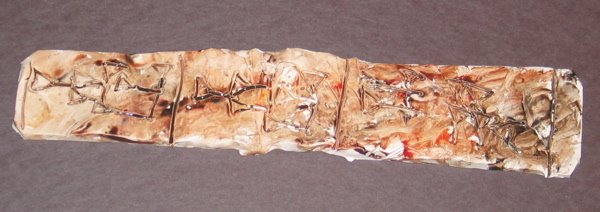 We are still working our way through The World in Ancient Times series by Oxford Press. Having finished Early Human World, we have moved to The Ancient Near Eastern World. The study of Mesopotamians as they begin to communicate through writing with their clay tokens and envelops, progressing to pictograms, and cuneiform is fascinating. We are using Sculpey for our recreations since it is much less messy than our natural clay. The clay tablet above has Pink Panther's monogram in cuneiform. Write like a Babylonian is a website that will convert your name and initials into a cuneiform monogram. The children then copied their monogram into clay and baked (and since our clay was sculpey, painted). The children found out that the seemingly simple cuneiform is more difficult to produce than it looks, and erasing on clay is easy but not precise.
I've learned many things too. First, I owe Henry Cate an apology. When he responded, in one of my planning entries, that he and his children started reading the Old Testament last year and were now in Kings, I thought (thank goodness I didn't open my big mouth) "They must be piddling around, only 10 books in a year." After two months, we are just finishing Genesis. I am sorry, Henry. I have learned that The Old Testament is dense and if we make it to Kings by next year we will be accomplishing something remarkable.
I have also learned that ancient literature is not devoid of the sexually explicit language and images that we so lament in television and advertisements of today. All literature, including The Old Testament (even if you have read it and think you know it) should be previewed to prepare you for edits or the questions that arise. The Old Testament is replete with incest, giving of slaves for pleasure or reproduction, murder, and surprising intrigue. The unabridged Gilgamesh, which I chose as a audio book for our ballet trips, has at least one "Oops!" section in which I was frantically looking for the mute button. Both of these books, I had read as an adult but not as a parent/educator of young children. There is a difference.
All in all, though we have not gotten to the more popular Ancient Greeks, Romans, Chinese, and Egyptians we are having a great time in history.
Tuesday, August 29, 2006
Having fun in History
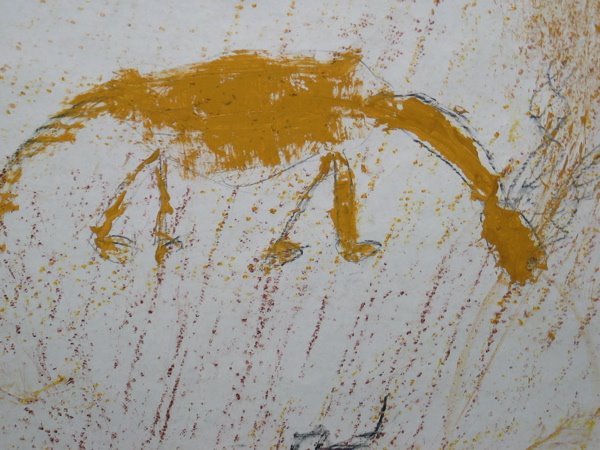 I think I have mentioned earlier that our home school is using The World in Ancient Times series published by Oxford for our history reading. We are loving the stories about archaeologists, anthropologists, and paleontologists in the first book, The Early Human World, who are making discoveries and attempting to place the pieces of our past. Yesterday, we read about Jean-Marie Chauvet, Christian Hillaire, and Eliette Deschamps finding cave art in December of 1994. The thrill of making a discovery and the significance of the art in the research of our past is documented in just enough detail for the children. Though the book has some great pictures, we took it a step further and looked at more pictures in Sister Wendy Beckett's The Story of Painting and the really cool website of the Cave of Chauvet-Pont-D'Arc.
 Take the tour!!
We, next, tried a cave art project from Art Smart by Susan Rodriguez. The children went outside and gathered sticks, dried grasses, bits of charcoal, and some roots to use as brushes. We then took butcher paper and placed it onto the concrete patio and texturized it with brown and tan crayons. After the paper was transformed into a cave wall, we hung it in the dog trot and Princess and Pink Panther started drawing animals and hands. They both commented that using the found tools was much more difficult and if they had it to do over again, they would know which things would make better tools and could do a better job.
I was excited because all the elements - books, art project, Internet site - came together to create something tangible, something fun, something they will remember. My husband came home and said that if it were darker he would have thought he was in a cave. That was just enough encouragement for the children to add more paper and art to the hallway. As long as I don't trip on the skull of a cave bear (or any other creature for that matter), let the transformations begin.
Subscribe to:
Posts (Atom)