
I hate to do this. I really like to post about one thing at a time, but I can't seem to find the time to post regularly. So here goes.
This.
I feel that having knowledge that a certain vice-presidential candidate didn't know that Africa was a continent, not a country (My children, who aren't old enough to vote, know that Africa is a continent and consists of many countries.), and not telling it until after the election is a mal-practice of journalism. The idea that Fox News would save this morsel until after the election is just plain telling. Yet, I suspect people who wanted to know, could guess the state of preparation from the Katie Couric interviews.
How demeaning to our intelligence and sense of right and wrong it is to try to play off a poser on the American people for the sake of a win. What a scary thing is this lack of knowledge especially if it is indicative of the state of education in America and America's curiosity about the world beyond our doorstep. How did we get to this place? Is she really an everywoman? The world is so global now that I find it difficult to imagine how you could leave school without a clear idea of continents and countries. And if you didn't have this base information, what would make you think it was appropriate to say yes. Was it ignorance or complete lack of respect for America?
That.
Jove, who has never lacked curiosity about anything, wanted more of my opinion about the bee decline. I don't think the decline is caused by one single thing. Insects, as are most animals, able to adapt to many stressers. Noticeable problems arise when there are a combination of stresses.
Jove asked specifically about the over harvest of honey and supplementing with high fructose corn syrup. I do believe, as I preached here, that commercializing bees and feeding substandard supplements is problematic. Dragging bees all over the country in 18-wheelers for commercial pollination just seems stressful, not just because the bees are separated from natural honey and fed cheap supplements, but because with the bees in such close proximity any disease, fungus, or mite can be easily transmitted. Any problems become noticeable quickly.
Add to commercialization of the pollination business, the use of genetically modified seeds, specifically corn that produces an insecticide in the pollen, and you create an additional decline. Yet, there is one other problem. The attempt to rid the nation of mosquitoes and other insects by broadcast spraying is devastating. Even in my rural county, a grant was sought and given for mosquito control. Instead of using the grant for education (emptying standing water, mosquito biting times, and effective larva control) they bought a sprayer and drove through the county roads spraying insecticide into the air. Because of lack of education about mosquito behavior, spraying started too early thereby killing bees that were still working and was rendered ineffective because it is impossible to spray the entire county from the road. Mosquitoes instead became immune to the chemicals and West Nile Virus was not reduced, yet bees were.
The Other.
I promised a book review of David Guterson's The Other back in the summer. Here it is.
When I first began reading this book, I was a bit disappointed. I thought it was nothing more than a thinly masked autobiography. You see I have read everything David Guterson has written including the homeschool book, so I knew he was a teacher (Countryman was a teacher), lived in the Northwest (the novel was set here as his others have been), and had other basic similarities of the character. I wasn't impressed because it seemed like a loosely tied journal purge.
But I kept reading. I kept reading to find that I could have been correct, but that the quality was hypnotic. I kept reading to struggle with questions of when to intervene if friends are damaging themselves. I kept reading to struggle with questions of hypocrisy, idealism, and worth. I kept reading because I was mesmerized. I had to know what happened to the Hermit of the Hoh in his attempt to live his convictions and how Neil mollified his conscience. I kept reading because the language was beautiful.
Showing posts with label bees. Show all posts
Showing posts with label bees. Show all posts
Thursday, November 06, 2008


Monday, October 27, 2008
Inquiring Minds
Zilla needs more information than I thought would be interesting in yesterday's post. Who knew that honey could be so fascinating? Nevertheless, here goes.
An Account of what I Know About Honey
Honey is the by-product of the bee's harvest of pollen and nectar so it stands to reason that the product would reflect the inputs. From a beekeeper's point of view there are two basic harvests, spring and fall. Spring/summer honey is generally a lighter color and has a lighter flavor (here is a picture of spring honey), whereas fall honey is darker and more strongly flavored (I'm looking for jar and will post it as soon as possible). Most commercial honey is either spring/summer honey or a mix of the two. Honey is graded for color and the lighter honey is always rated higher.
Some commercial and small farm honey claims to be clover honey or citrus honey and they may well be, but I've found that I can't really control where my bees forage. Perhaps I'm not trying hard enough. I've seen lavender honey and apple blossom honey advertised, but I remain skeptical. In order to achieve fair labeling, a bee keeper would have to add honey supers exactly when the blooming is the most prevalent species available and remove them immediately after pollination or when the blooms begin to wane. They would also have to know that the bees only sought nectar in that orchard or field and didn't go to the next field for a little basil, sunflower, or oak tree pollination. Managing all this is more than a little difficult. So I wouldn't pay extra for an exotic honey unless you have tasted it first and find the claims to be true. With all that nay-saying, I do have to say that I can taste subtle differences in honey. As we harvest frames, I can generally tell whether the honey is clover inspired or fruit tree inspired, but I have tasted a lot of honey over many years. As far as seasonal variances, you don't need acute taste buds. The differences are dramatic.
Now, natural medicine advocates say that if you have fall or spring allergies, take a teaspoon of local, raw honey from the season each day. So, if you are allergic to fall, take a teaspoon of fall honey each day and the following fall you should have fewer symptoms. Go find a local apiary, get some raw, wildflower honey, and be beealthy. You also get that feel good sensation for supporting a local, small farmer. Why does the honey have to be raw and local?
Raw honey is minimally processed - no heat and minimal filtering. As my brother says, "Give me some of that honey with the legs and wings in it." Honestly, you don't want bee parts in your honey, but you should try to find natural honey in its bee produced perfection. Finding local honey is just as important as finding raw honey, not for the carbon saved, but for the health benefits. If you live in Mississippi and you have spring allergies you aren't reacting to almond blossoms or California wildflower blossoms, you are reacting to pecan, oak, or Mississippi wildflowers. Dose accordingly.
Bon Appetit
An Account of what I Know About Honey
Honey is the by-product of the bee's harvest of pollen and nectar so it stands to reason that the product would reflect the inputs. From a beekeeper's point of view there are two basic harvests, spring and fall. Spring/summer honey is generally a lighter color and has a lighter flavor (here is a picture of spring honey), whereas fall honey is darker and more strongly flavored (I'm looking for jar and will post it as soon as possible). Most commercial honey is either spring/summer honey or a mix of the two. Honey is graded for color and the lighter honey is always rated higher.
Some commercial and small farm honey claims to be clover honey or citrus honey and they may well be, but I've found that I can't really control where my bees forage. Perhaps I'm not trying hard enough. I've seen lavender honey and apple blossom honey advertised, but I remain skeptical. In order to achieve fair labeling, a bee keeper would have to add honey supers exactly when the blooming is the most prevalent species available and remove them immediately after pollination or when the blooms begin to wane. They would also have to know that the bees only sought nectar in that orchard or field and didn't go to the next field for a little basil, sunflower, or oak tree pollination. Managing all this is more than a little difficult. So I wouldn't pay extra for an exotic honey unless you have tasted it first and find the claims to be true. With all that nay-saying, I do have to say that I can taste subtle differences in honey. As we harvest frames, I can generally tell whether the honey is clover inspired or fruit tree inspired, but I have tasted a lot of honey over many years. As far as seasonal variances, you don't need acute taste buds. The differences are dramatic.
Now, natural medicine advocates say that if you have fall or spring allergies, take a teaspoon of local, raw honey from the season each day. So, if you are allergic to fall, take a teaspoon of fall honey each day and the following fall you should have fewer symptoms. Go find a local apiary, get some raw, wildflower honey, and be beealthy. You also get that feel good sensation for supporting a local, small farmer. Why does the honey have to be raw and local?
Raw honey is minimally processed - no heat and minimal filtering. As my brother says, "Give me some of that honey with the legs and wings in it." Honestly, you don't want bee parts in your honey, but you should try to find natural honey in its bee produced perfection. Finding local honey is just as important as finding raw honey, not for the carbon saved, but for the health benefits. If you live in Mississippi and you have spring allergies you aren't reacting to almond blossoms or California wildflower blossoms, you are reacting to pecan, oak, or Mississippi wildflowers. Dose accordingly.
Bon Appetit
Sunday, October 26, 2008
Honey Harvest
 One of the things I've been doing when I haven't been writing is harvesting honey. Actually, we harvested about a month ago, but we returned some of the extracted comb to the hive for a fall flow. I know it doesn't seem logical to those of you who are already shivering, but we are in the prime of goldenrod and fall flower season. We'll slip these fall supers off at the end of November when the temperatures start dropping in earnest.
This last hive check will give us an idea of which hives will need a little extra help in winter and which hives have all the honey and pollen they need until the spring.
 We don't count individual bees, but we do like to have a general idea of bee population going into the winter. Once the weather turns cold, we won't pop the tops.
Anyway, honey harvest is a family production. There is a job for every person. Honey supers have to be removed, jars have to be sterilized, cappings have to be removed, the extractor has to be spun, comb honey has to be cut and jarred, and jars have to be filled and sealed. Our goal was to be finished in one day. We weren't, though we were incredibly more efficient.
Confession. I still have a pot of comb and cappings that need cleaning sitting on my kitchen cabinet. Perhaps today will be the day I tackle it.
Saturday, June 28, 2008
Bees in the Corn
 This morning I did a hive entry check because last night, while I was sitting on the porch as a thunderstorm went right around us, AGAIN, I thought I noticed fewer bees hanging on the front of hive number 1. Fewer bees could have been caused by the cool, damp breeze blowing in or it could be a sign of trouble. Anyway, I stood around in front of the hives today and I saw lots and lots of bees with enormous panniers of pollen. See the little yellow pocket to the right of the bee. Go ahead, click the picture for a better look.
I did a quick look around and realized the corn had bloomed and the bees were sneaking over the fence to partake. The bees love this stuff, though harvesting corn pollen has no economic benefit since corn self-pollinates.
Hold up a minute. Let me climb on my stump.
Many commercial beekeepers forget this important, natural step in the hive year. When the beekeepers become paid pollinators for crops requiring insect pollination, the needs of the bees are neglected. Years ago, bees were more viable because there were more backyard keepers and farmers who kept their own pollination hives, which allows them to stay on the property for the entire year. During the stationary hive year, the bees are allowed to forage for the nutrients needed to keep healthy, while those on the road are fed inferior replacements.
If we let the bees gather corn pollen, would we be any better off? With all the genetically modified corn out there, I'm wondering if the bees need to be left to their own devices. Could the genetically altered corn be the one thing that is killing the bees?
We grow only organic, non GMO, corn here, so I let (like I am in full control of all my 120,000 plus bees) my bees eat all they want, but I do wonder about the other, not so lucky bees (I'm also lucky, none of my neighbors are corn growers). If corn is genetically altered to produce Bt in the pollen, which it is, then is not the pollen an insecticide?
Perhaps cheap corn isn't as cheap as it seems.
Friday, March 21, 2008
Swarm
 Wednesday, during school, because we were completely unprepared for spring beekeeping since we have had such strange weather, K and I noticed a swarm developing outside of our rough and tumble hive number two. Though timing wasn't perfect because of wind and impending thunderstorms, having a hive swarm in the spring is not a bad thing. In fact, spring swarming has even been recognized as a good thing in the children's picture book, Beekeepers by Linda Oatman High, with this nice ditty:
A swarm in May
Is worth a load of hay.
A swarm in June
Is worth a silver spoon.
A swarm in July
Isn't worth a fly.

As is usual our seasons are not the same as depicted in most books, so perhaps a swarm in March is worth, let's see. . . What rhymes with March that is as good as a silver spoon???
Having a husband who will come and climb the shaky ladder with gigantic pruners, hang onto the branch loaded with bees with one hand while bracing the loppers against his body to make the cut, maintain control when the ladder starts sinking into the wet hill, and then successfully hive the swarm is priceless.
Anyway, because the wind was blowing so hard, K and I had to wait and chase the swarm for a long time. As soon as they looked as if they were going to settle a huge gust of wind would blow, the bees would change their minds, and we would wait and watch, watch and wait, wait and watch.

Once they finally settled in a fir tree branch that was hanging over the edge of a hill, we called Mr. W. We share bee keeping duties, and since these bees came out of that persnickety hive that has given me trouble in the past, I decided this swarm was his. Wasn't that nice of me?
Before you think I'm mean, let me assure you that bees don't normally sting during swarming. I suppose they don't really have anything to protect. I took that first picture without a zoom lens and without a bee bonnet. K took the rest. We never donned our beekeepers suits.
While I did have a hive built and painted, it was no where close to being ready for bees since it was in the shed with no frames.
 While Mr. W captured the swarm, I got the box ready and decided where to put it. With a swarm from one of our hives, we need to make sure the new hive placement was not too close to the mother hive. I don't like drifting bees who jump from hive to hive, so I make sure to place the new hive well away so there is no confusion.
Once you set your location and get your hive placed, add about six frames (not all ten) so that you will have room for the bees. Sprinkle the bees with water so they won't fly, then shake them in the hive.
 Close the hive, reduce the entrance.
Now all there is to do is to keep a close watch and provide sugar water until they build out the first level of wax foundation and start laying and putting aside honey.
Tuesday, July 31, 2007
Mounds of Wax Cappings
 And ruined comb are draining in two huge dishpans and a mixing bowl in the kitchen. The three foot tall extractor is still waiting for me to disembowel and clean. Honey that dripped from the cappings (The prized fine wax that bees use to seal the honey into the comb) is waiting to be jarred. So, I have barricaded myself in my office in an attempt to feign a life of leisure. Unfortunately, the plan is not working. I cannot seem to forget. Yet I can't seem to find the motivation to tackle the messy business.
The days after harvest are the worst part of beekeeping. Moving the heavy honey supers, turning the extractor handle, sterilizing umpteen million jars, and honey dripping everywhere on the first day is hard and messy work, but the leftovers are always more annoying. Sure we could just toss everything in the garbage, but the waste would worry me more than the mess of extracting the last of the honey and saving the cappings and fresh, but not perfect comb. Time to let gravity pull the last of the honey from the wax means a cluttered kitchen (which is usual for me) and a messy job hanging in the queue. Once the honey is finished draining and jarred, the wax will be cleaned of bee parts and stored until I make candles, which won't be done until I get finished storing all of the precariously close to spoiling tomatoes that are covering all of the other surfaces of my kitchen.
Which leads me to the all important question, "Why have I barricaded myself in my office when there is so much to be done?" Fellow procrastinator to whom I loaned the book about overcoming procrastination that my mother loaned to me, if you could put returning the book on your To Do List, I would appreciate it. I am in dire need of a refresher course.
Monday, July 30, 2007
Did you know that . . .
 Bee stings are great for arthritis pain and other joint maladies? Though no doctors are prescribing getting stung by real bees because of the dangers associated with allergic reactions (nor do I recommend it), I feel smug about my joint health as I sit nursing three stings today and knowing that I endured eight stings last week. We harvested honey yesterday. My job was to bring the frames inside, cut the cappings, extract the honey, then jar it. Notice I didn't get anywhere near the hive, yet I still managed to get stung. Mr. W., who harvested the honey, didn't get a single sting. I resent his sting-free harvest.
Not really. Last week we had a hive calamity, which is why we are harvesting this week, and he was stung more times than we could count, so I'm really glad he didn't get stung. Friday, a week ago, we had a thunderstorm with much wind and a good bit of rain in a short period of time. The ground shifted under a hive with two brood chambers and three honey supers and the wind blew the whole hive into a pile. As chance would have it, this was our feisty hive. Some truly mad bees combined with a few careless mistakes trying to get the hive back together resulted in a bonnet full of bees that ended Mr. W's bee keeping night. My brother came in full gear (including a winter coat) to help me finish getting the hive protected from the elements and off the ground.
Working bees at night is not optimal. The next day was no better. I went to retrieve some equipment and frames left in our frenzy (and fear) and the bees were still furious. I left the stuff for a few more days. Sunday the bees were back to their normal mean personalities, so we decided to harvest honey to get some weight off the hive, make sure the hive was stable, and check hive health (see if the queen was still alive).
We harvested about 6 gallons of honey from the one hive. I know most people figure honey harvest by weight, but we don't have a scale. And I know my calculation of jarred honey is flawed because we put up some chunk honey and some extracted honey, but I still think 6 gallons of Spring/Summer honey from one hive is outstanding. We don't mind their feisty demeanor as much when they provide so well for our sweet tooth.
Tuesday, June 12, 2007
Aren't Y'all Lucky
 This garden picture was too good not to post, so you get two entries in one day. Think how great the picture would be if my camera was better. When I went to the garden to pick today's bounty (I added a picture of that, too), I heard so many bees that it sounded like a swarm. They were gathering pollen from the corn. Now, many people(experts included) say corn is pollinated by the wind, but those people have never stood in my garden and watched the bees completely work the corn. My son noticed bee activity in the corn a few days ago, but today the bees were so loud and so many that I called for the camera. With so many bees around, I felt sure I could get a focused picture. I wanted to show the pollen packs of the legs of the bees. I didn't get that picture, but look at this bee collecting. The yellow on her back legs is pollen. After a while she will have huge yellow thighs, temporarily of course.
Here is the haul for the day - French filet beans and patty pan squash. Obviously there are more beans today than my family can eat in a single sitting so I will share with my sisters or mother. I don't like the way these beans freeze or can. They have such a nice texture and flavor when lightly cooked that I find I am disappointed when I eat these same beans cooked to death - blanched, hot water bathed or frozen, then reheated. I grow these beans to eat in the summer and the rattlesnake beans for canning.
Monday, June 11, 2007
Sunflowers


 And Zinnias are blooming along my garden fences. I planted five varieties of sunflowers. These must be the early bloomers, but I don't know what they are called. I'm weird like that. I scrutinize every seed name and struggle with which to plant, but once it is out there, I couldn't tell you its name to save my life. I do, however, have the ability to go look it up. I will. I found the name and it does actually fit the flower - Big Smile. I do smile when I see it.
The bees are smiling, too. Do you like the way I captured one of my bees on the sunflower? That wasn't the plan, but she was there and wouldn't move even after four or five shots, so I let her stay. What harm is there in shamelessly promoting honey bees?
Carousel Zinnias are beautiful, though not as big as last year's State Fair version (I still have the file in front of me). Every flower has been a different color, so far. There are pink and white, red and yellow, purple and pink, and red and pink. I look at the zinnias first every morning, just to see what pops up next. They, too, make me smile.
The last picture is lunch. Obviously, I haven't cooked it yet, but I picked this mess of rattlesnake beans and zucchini this morning when I picked the cucumbers for pickles. I'll do a little cornbread to go with it.
Friday, May 04, 2007
Swarms of Bees
 Sunday, minutes before Princess and I were scheduled to leave for Jackson, Pink Panther came inside and said he heard bees in the front yard. He didn't mean a few working bees, he meant a swarm. They were settling in the top of a cedar tree. Timing and location are not always perfect.
I built a hive top, the only piece missing for a complete hive, while my husband went to borrow a scissor lift. Princess and I had to skedaddle or risk missing the show. Mr. W had never hived a swarm, much less one that was hanging in the top of a tree. He called once everything was ready and I talked him through the basics.

Before we got to Jackson, the swarm was hived and the equipment was returned. Before we got home the bees had moved again. We have a weak hive, not because of the bee collapse syndrome but because of a weak queen. Unfortunately, we haven't been able to get a new Mississippi raised queen because of the increased demand caused by the collapse. My regular bee man doesn't answer the phone, another said he was filling an order for 600 queens, and yet another is completely out. There are queen chambers in the hive, so supersession will occur, but since the children help with the beekeeping I don't really want to take chances with a hive produced queen who could turn out to be a dragon lady producing dragon babies. Anyway, the swarm moved over to this weak hive. I wasn't there to see it, but it had to have happened, because when I got home the weak colony was bursting at the seams and the new colony was empty.

I was alright with the move, yet there just didn't seem to be enough room for everyone. I like hives full of bees because you get lots of honey, but this was ridiculous. The bees thought so too! They swarmed again! As I mentioned before, you can't choose time or place.
This time the bees chose lunch time and my one year old plum tree. Obviously, the usual technique of capturing a swarm would not work. I would not allow the top of my plum tree to be "pruned." So, Mr. W. who is excited about hiving swarms came up with another plan. He got a bucket of water, doused the bees so they couldn't fly, and shook the little plum tree until the bees fell into the hive. My poor little plum tree. The poor bees. He didn't get them all.

The rest flew to the next plum tree. After Mr. W. went to work, I had to lop a branch of my plum tree to get the bees to the hive. Now two of my plum trees have been misshapen - one by pruning and the other by bending and shaking. But, we have a new enormous colony that seems to be staying put. We will keep the entrance reducer in for a few days to protect them and then begin to feed them sugar water, not high fructose corn syrup.
I suppose that by showing this immediately following my sustainability sermon yesterday, I wanted to say that there is hope. Healthy bees are still around. They just need to be nurtured and their environment needs to nurtured. They need to be appreciated rather than swatted.

One more picture? This is a hive with two honey supers. Do I dare to go higher or start the sticky work of harvest?
All photo credits for this post go to The Pink Panther.
Thursday, May 03, 2007
Bees!
ZBTZahBTzoo asked yesterday about my take on the bee collapse, so I feel like I have been given permission to drone on and on about bees. I've been keeping up with the story, with fear. I don't want to lose my bees. We are just hobby keepers, so our financial livelihood does not depend on pollination fees, queen production, package bees, or honey production, however, we've grown to depend on them for pollination of our garden and trees, for sweetening, and gifts. The bees are an integral part of our long term sustainability plan.
Lack of sustainability, in my opinion, is causing the bee collapse. The dependence on pesticides, herbicides, cheap and lower quality sweeteners, and the move away from self production of food are contributors to lack of sustainability and the stress on honey bees. In the attempt to "bigger"* farming the best practices have fallen to the wayside.
Pesticides are used to kill both good and bad insects thereby ending the natural cycles of nature. Did you know that it takes twice as long for the predator bugs to reestablish after pesticide use? Since pesticide use eliminates predators (good bugs) you insure you will always have to use pesticides to keep ahead of the pest bugs. Sure, no orchardist is going to spray pesticide on trees that are being pollinated, but the residue is there and you can never control what your neighbor sprays or dusts. You also cannot control where a bee will go. The practice of broad pesticide use to ease the production of mass quantities of perfect appearing fruit and vegetables with the least amount of work is weakening the pollinators (not just the honeybees), if not killing them. Farmers aren't the only ones spraying pesticides. Towns frequently spray for mosquitoes. Fumigating a town, in my opinion, is poisoning the people and the bees.
Though many scientists say herbicide use is not as dangerous to the environment as pesticide use, I believe that herbicides do injure wildlife. There is nothing preventing bees and other insects from landing on sprayed weeds. The sharp odors of the herbicide would have to befuddle any creature. Our quest for ease in gardening, large scale farming, and landscaping leaves best practices by the roadside. Speaking of roadsides, the willy-nilly spraying of the various Departments of Transportation kills everything within wand distance. What makes it senseless is that they still send a mowing crew.
Backyard beehives, at one time, were not uncommon. Families had fruit trees, gardens, and bees. Bees were able to feed on a seasonal diet and depend on the cycles of nature. Now, beekeeping, for the most part, is handled by commercial operations that also want to "bigger." Bees are stressed by cross country transportation so that they can pollinate crops as Spring arrives in each area of the country. To supplement their natural diets, bees are fed high fructose corn syrup instead of foraging naturally or sugar water. Best beekeeping practices have been forgotten in the name of pollination dollars and pollination dollars are necessary because the glut of cheap sweeteners at the grocery stores don't allow beekeepers to make enough on honey to survive.
Sure, there may be fungi or parasites. In Mississippi, beekeepers have struggled terribly with mites. But, I do know that strong colonies are not as susceptible to illness. Haul bees 2,000 miles in the back of a trailer and I feel sure any incubating illness or parasite will show itself. Moving back to more localized agriculture and a return to smaller, best practices farming, rather than quickest, easiest, and biggest farming would go a long way towards bolstering the honey bee. Yet, that is easier said than done. Farmers have been forced financially to abandon best practices. To stay in business you must have economies of scale. To compete with foreign suppliers (who it turns out are not supplying the same quality) getting the most and cheapest to the market usurps the best practice of rotation planting to avoid poisoning with chemical fertilizers and pest problems and encourages herbicide use, defoliates, and pesticide use. Unfortunately, only the chemical companies are thriving.
I am as guilty as the the next person of supporting large scale agriculture. I have enjoyed cheap grains and meats, almonds, more delicious apples than we can grow in Mississippi, citrus when I want it, and avocados. Yet, I have lately (last 8 years) been struggling with food quality and wondering whether cheap foods that don't really have a taste are worth it. With all the scary news articles about non-nutritive food additives in chicken, fish, cattle, and pig feed, I am getting scared to eat. I just feel that we have moved so far away from our food sources, that what we eat is barely recognizable. The honey bees know it, too!
* from The Lorax by Dr. Suess. Read this book!
Lack of sustainability, in my opinion, is causing the bee collapse. The dependence on pesticides, herbicides, cheap and lower quality sweeteners, and the move away from self production of food are contributors to lack of sustainability and the stress on honey bees. In the attempt to "bigger"* farming the best practices have fallen to the wayside.
Pesticides are used to kill both good and bad insects thereby ending the natural cycles of nature. Did you know that it takes twice as long for the predator bugs to reestablish after pesticide use? Since pesticide use eliminates predators (good bugs) you insure you will always have to use pesticides to keep ahead of the pest bugs. Sure, no orchardist is going to spray pesticide on trees that are being pollinated, but the residue is there and you can never control what your neighbor sprays or dusts. You also cannot control where a bee will go. The practice of broad pesticide use to ease the production of mass quantities of perfect appearing fruit and vegetables with the least amount of work is weakening the pollinators (not just the honeybees), if not killing them. Farmers aren't the only ones spraying pesticides. Towns frequently spray for mosquitoes. Fumigating a town, in my opinion, is poisoning the people and the bees.
Though many scientists say herbicide use is not as dangerous to the environment as pesticide use, I believe that herbicides do injure wildlife. There is nothing preventing bees and other insects from landing on sprayed weeds. The sharp odors of the herbicide would have to befuddle any creature. Our quest for ease in gardening, large scale farming, and landscaping leaves best practices by the roadside. Speaking of roadsides, the willy-nilly spraying of the various Departments of Transportation kills everything within wand distance. What makes it senseless is that they still send a mowing crew.
Backyard beehives, at one time, were not uncommon. Families had fruit trees, gardens, and bees. Bees were able to feed on a seasonal diet and depend on the cycles of nature. Now, beekeeping, for the most part, is handled by commercial operations that also want to "bigger." Bees are stressed by cross country transportation so that they can pollinate crops as Spring arrives in each area of the country. To supplement their natural diets, bees are fed high fructose corn syrup instead of foraging naturally or sugar water. Best beekeeping practices have been forgotten in the name of pollination dollars and pollination dollars are necessary because the glut of cheap sweeteners at the grocery stores don't allow beekeepers to make enough on honey to survive.
Sure, there may be fungi or parasites. In Mississippi, beekeepers have struggled terribly with mites. But, I do know that strong colonies are not as susceptible to illness. Haul bees 2,000 miles in the back of a trailer and I feel sure any incubating illness or parasite will show itself. Moving back to more localized agriculture and a return to smaller, best practices farming, rather than quickest, easiest, and biggest farming would go a long way towards bolstering the honey bee. Yet, that is easier said than done. Farmers have been forced financially to abandon best practices. To stay in business you must have economies of scale. To compete with foreign suppliers (who it turns out are not supplying the same quality) getting the most and cheapest to the market usurps the best practice of rotation planting to avoid poisoning with chemical fertilizers and pest problems and encourages herbicide use, defoliates, and pesticide use. Unfortunately, only the chemical companies are thriving.
I am as guilty as the the next person of supporting large scale agriculture. I have enjoyed cheap grains and meats, almonds, more delicious apples than we can grow in Mississippi, citrus when I want it, and avocados. Yet, I have lately (last 8 years) been struggling with food quality and wondering whether cheap foods that don't really have a taste are worth it. With all the scary news articles about non-nutritive food additives in chicken, fish, cattle, and pig feed, I am getting scared to eat. I just feel that we have moved so far away from our food sources, that what we eat is barely recognizable. The honey bees know it, too!
* from The Lorax by Dr. Suess. Read this book!
Wednesday, May 02, 2007
Japanese Privet
 Japanese Privet, technically called Ligustrum japonicum is a pest plant here in Mississippi. The plant thoughtfully placed in some one's landscaping has become an invasive species. When we first moved onto the hill, we took a backhoe (yes, it is that stubborn) and ripped privet and fence row to clear the view immediately surrounding the house. We pitted the yard trying to remove every last root. But removal is elusive. We still have a beautiful specimen flowering next to a mature tree.
As you can see we still have fence rows that don't really need fences because of the thick cover of J.Privet. To the locals and the US Forestry Service the plant has become a pest.

Yet, the blooms are beautiful and the sweet fragrance perfumes the entire farm (actually the town and outlying area). Unless someone is burning or spreading chicken fertilizer this is what you smell here in early May. The cows loll in the shade. The brown thrashers love the messy fence rows. And, when you have bees hanging on their hives, the privet is a welcome nectar and pollen plant. Look at the pollen on the leaves in the first picture. In fact, we have been busily assembling honey frames to try to keep up with the bees' production in this privet induced honey flow.


After the flowering, the privet produces a little purple fruit on which the birds feast all winter.
So, I wonder if all invasive species are bad?
Other than trying to take over yard, garden, and pastures, Japanese Privet seems to give much to nature and farm.
Saturday, March 10, 2007
Spring in the Air
 Even though Miss Betty, my consultant for all old timer knowledge, says there will be a frost on April 28 because it thundered on the 28th of February, I feel Spring.
The purple clover is blooming in the orchard. My husband is straining at the bit to crank the lawnmower and shear it. He says it is unsightly, but I say leave it. I do wonder what the neighbors think. If they could hear the hum, the buzz, the throb of the many insects using this section of untidy lawn, could they be swayed to see my point of view?

I caught one (actually hundreds) of my bees collecting pollen and nectar. There were also bumble bees, spiders, gnats. . .
Now, I have to get to work so I can keep up with Spring. There are bee hives to build and repair, aged manure to spread, seeds to plant. The wisdom of the old farmers' wives has spoken, so I know not to get too far ahead of myself, but with the temperatures rising, the birds singing, and trees blooming, and the bees buzzing it is hard to resist.

Sunday, October 22, 2006
A Subtle Change
When I woke this morning, I noticed that, seemingly overnight, the seasons have changed. Though the temperature is not cold (cool by our standards but not cold), there is something about the light and air that says get ready for winter. Again, winter here is not the same as a Northern winter, but some preparation is needed.
Just yesterday, we harvested honey which screams of Summer. My brother, in fact, questioned my sanity because of yesterday's harvest. He didn't understand I still had the honey supers on the hive. He thought I was taking Winter food from the brood chambers which I would never do even in Summer. Even though it was late in the year, yesterday was a perfect harvest day, warm, but not too hot, and sunny. Harvesting honey is great fun. The children both think it is better than computer games and running around outside. I think what they really mean is that they like the perks of honey harvest - the shards of comb dripping with honey. We run a small bee operation so we don't have a dedicated honey place. My kitchen is sticky but we are waiting for the cappings to drain to produce the last quarts of honey before we do the major cleaning. Obviously we did spot cleaning and cleaned the thruways, but a major scrub is in order later today.
This afternoon we gathered pecans stripped from the trees by the wind and rain last night. Gathering nuts screams Fall, especially if you are a squirrel.
Instead of actual cues in nature such as temperature, light, color, and air, maybe I have just decided it is time so I am more attune to the signs that have been around for a while. But I think the animals have just noticed, too.
Just yesterday, we harvested honey which screams of Summer. My brother, in fact, questioned my sanity because of yesterday's harvest. He didn't understand I still had the honey supers on the hive. He thought I was taking Winter food from the brood chambers which I would never do even in Summer. Even though it was late in the year, yesterday was a perfect harvest day, warm, but not too hot, and sunny. Harvesting honey is great fun. The children both think it is better than computer games and running around outside. I think what they really mean is that they like the perks of honey harvest - the shards of comb dripping with honey. We run a small bee operation so we don't have a dedicated honey place. My kitchen is sticky but we are waiting for the cappings to drain to produce the last quarts of honey before we do the major cleaning. Obviously we did spot cleaning and cleaned the thruways, but a major scrub is in order later today.
This afternoon we gathered pecans stripped from the trees by the wind and rain last night. Gathering nuts screams Fall, especially if you are a squirrel.
Instead of actual cues in nature such as temperature, light, color, and air, maybe I have just decided it is time so I am more attune to the signs that have been around for a while. But I think the animals have just noticed, too.
Monday, October 02, 2006
Single Farming and Single Parenting
My husband left for a three week business trip Saturday at 5:30 a.m. I am used to the routines of single farming and parenting because he travels frequently, but so far this has been a humdinger. We have had three baby calves and one of our hives swarmed.
I have done fine with the calving, which though unscheduled is obviously in full swing (2 yesterday). We let the cows calve in the pasture, only moving them to the barn if there is distress. I have been able to keep tabs on springing cows and watch them closely. So far, there has been no trouble and my only job is to monitor and record, which in itself is an adventure.
I have been letting Pink Panther drive me around the pasture. He has only been driving the truck for a few months and he still can be abrupt with the brake and acceleration. I practice patience. Yesterday, after having been launched into the windshield, I physically removed him from under the steering wheel while we were moving, promising that he would not be allowed anywhere close to the driver's seat until he was 16. He laughed and said, "You know that's not true." I did know it. I hate when I threaten with impossibilities.
With the bee swarm, I didn't do so well. Bees swarming at this time of the year is not good. It weakens the wintering colony and the swarmed bees have to be fed all winter long. They swarmed when the temperatures rose after those few weeks of gloriously cool weather. They were tricked into thinking it was Spring. I captured the swarm in a cardboard box, because we didn't have any hive bodies, using a white sheet as a base. I was proud of my resourcefulness. Before I went to bed, I placed a couple of bricks on the corners of the box so Yellow Dog, some other animal, or the wind couldn't move the temporary hive. This morning I checked the hive and the heavy dew had settled the box and apparently closed the entry. There were also ants everywhere. My small Fall swarm is so small now that it is unlikely to survive. I feel terrible - a failure at animal husbandry.
I wonder what will be next.
I have done fine with the calving, which though unscheduled is obviously in full swing (2 yesterday). We let the cows calve in the pasture, only moving them to the barn if there is distress. I have been able to keep tabs on springing cows and watch them closely. So far, there has been no trouble and my only job is to monitor and record, which in itself is an adventure.
I have been letting Pink Panther drive me around the pasture. He has only been driving the truck for a few months and he still can be abrupt with the brake and acceleration. I practice patience. Yesterday, after having been launched into the windshield, I physically removed him from under the steering wheel while we were moving, promising that he would not be allowed anywhere close to the driver's seat until he was 16. He laughed and said, "You know that's not true." I did know it. I hate when I threaten with impossibilities.
With the bee swarm, I didn't do so well. Bees swarming at this time of the year is not good. It weakens the wintering colony and the swarmed bees have to be fed all winter long. They swarmed when the temperatures rose after those few weeks of gloriously cool weather. They were tricked into thinking it was Spring. I captured the swarm in a cardboard box, because we didn't have any hive bodies, using a white sheet as a base. I was proud of my resourcefulness. Before I went to bed, I placed a couple of bricks on the corners of the box so Yellow Dog, some other animal, or the wind couldn't move the temporary hive. This morning I checked the hive and the heavy dew had settled the box and apparently closed the entry. There were also ants everywhere. My small Fall swarm is so small now that it is unlikely to survive. I feel terrible - a failure at animal husbandry.
I wonder what will be next.
Thursday, June 22, 2006
Garden Helpers
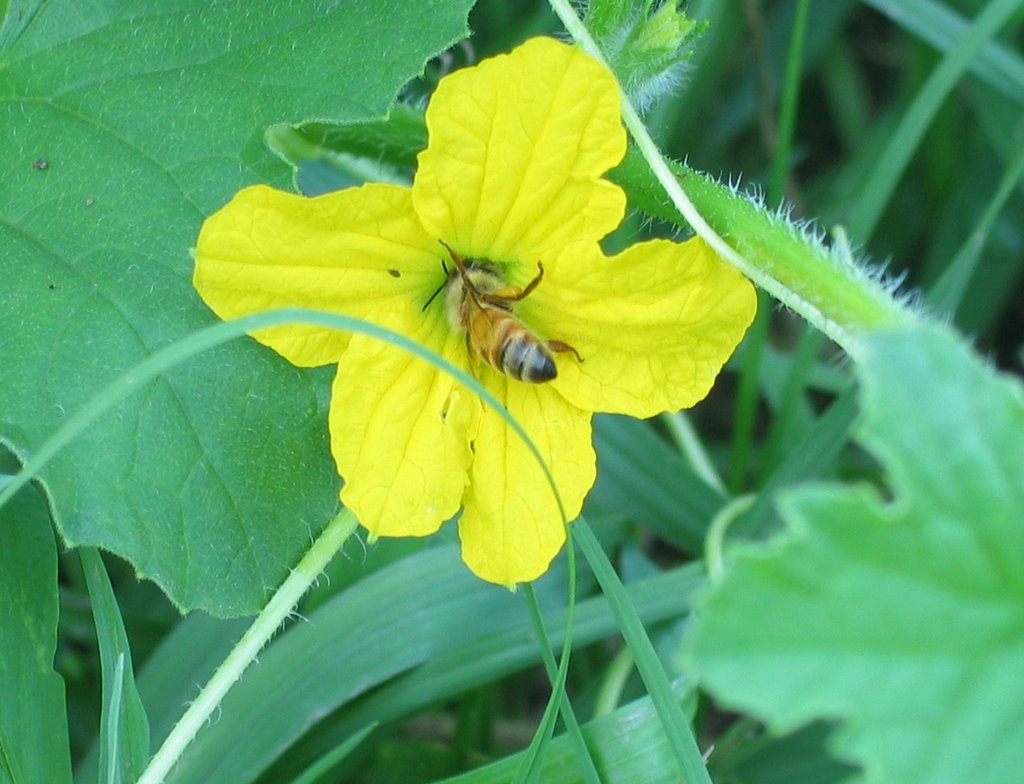 This morning I was weeding the cantaloupe plants before they spread so that it is impossible to get around without crushing the plants. I know that they are trainable to a neat trellis, but I think they produce more if they get to run amuck. Plus, I like the chaos of never knowing where you might find the next melon.
Anyway, I heard tons of buzzing and there was a bee in almost every single bloom. I yelled for one of the children to get the camera. While I was waiting I noticed something that I had never noticed before. An individual bee does not enter the same flower twice. They move methodically from one flower to the next. If they come back to a flower I guess they can smell themselves because they don't enter - only hover above. Other insects or a different bee might come later, but the same individual does not re-enter. Cool. Think how many weeds I could have pulled while I was watching the bees.

Look what else I found - baby cantaloupe! My bees are obviously doing their job. So much is going on in the garden right now that I can barely keep up. I harvested more tomatoes. Weeded. Picked some yellow wax beans. Weeded. Watered. Weeded. Watered.
I need to stay out there all day, but the heat and humidity make gardening a morning venture.
Wednesday, May 24, 2006
Small Bee Emergency
 Yesterday, when we got back from the Delta, my husband said, "Take a look at the bees. There are more than usual out on the front." The temperature was over 90 degrees so bees should be out of the hive, but there were still too many. I didn't think these new hives would need another brood chamber yet, but I was wrong. The other colony is not as strong, but this one is bursting at the seams.
So, today my husband and the Princess added another brood chamber and re-arranged the frames so that there are only 9 frames in the lower hive body. Losing a full brood frame to the upper chamber helps the bees move up faster and also makes it easier to remove frames and inspect bees. We use two different colors for hive bodies - green and white - so we can keep track of the rotation. The green frame in the white hive body is a plastic drone foundation. Supposively, mites prefer the drone larva, so we have one drone foundation per hive. Once the comb is built, the eggs laid, larva formed and sealed we will remove this frame and freeze it, thereby killing the mites. When we replace it, the bees will clean out the dead larva and the process begins, again.
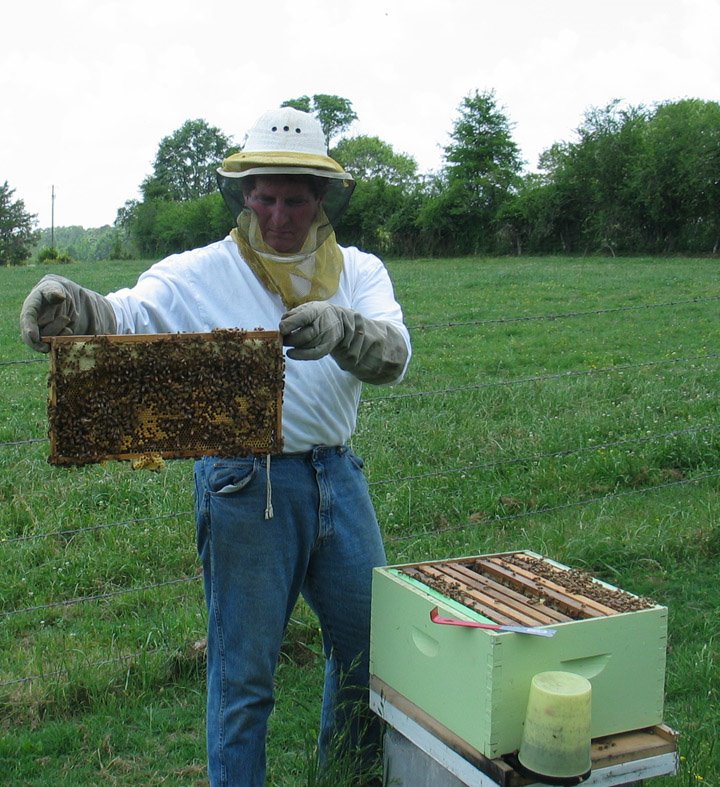 The children started helping with the bees when they were 3 - just old enough to hold the smoker or hive tool. My son, when he was three, dropped the smoker into the bottom of a double hive when I had about half of the frames out looking for a queen during a requeening. The bees were not happy, so I told my son to run. Unfortunately, I had chosen this day to throw caution to the wind by wearing black pants. Most of the bees came out of the hive and attacked my pants (my legs), but I was able to maintain my composure and reconstruct the hive. I don't ever wear black pants anymore (except last month when my friend's bees swarmed and one other time)
Beekeeping started as my hobby. My husband was not interested at all. We still lived in town and he thought we would be a nuisance to our neighbors. Once we got the first hive, he began watching the proceedings from a distance.
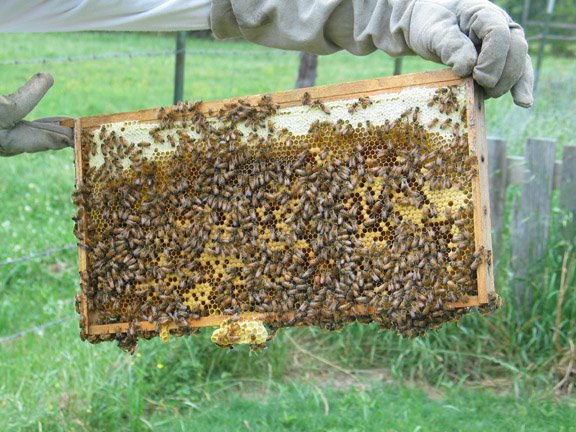 Then he moved closer and closer. Now we have to take turns working the hives. He loves it. Today was his turn to handle the frames, though we were all out there looking. In the last picture you can see a typical brood frame with capped honey at the top, some "green honey" below, and different phases of brood below. That glob on the bottom is free form brood. We removed it. Some bees keep a neat chamber and others tend to build and glue anywhere. We prefer these bees, even though they make globs because they are so calm that I trust my children to be around them, even in short sleeves.
With these strong young queens we could have double brood chambers and honey by the end of the summer in these two new hives. These bees earned the cliche, "As Busy as Bees."
Sunday, May 21, 2006
Hive Entry
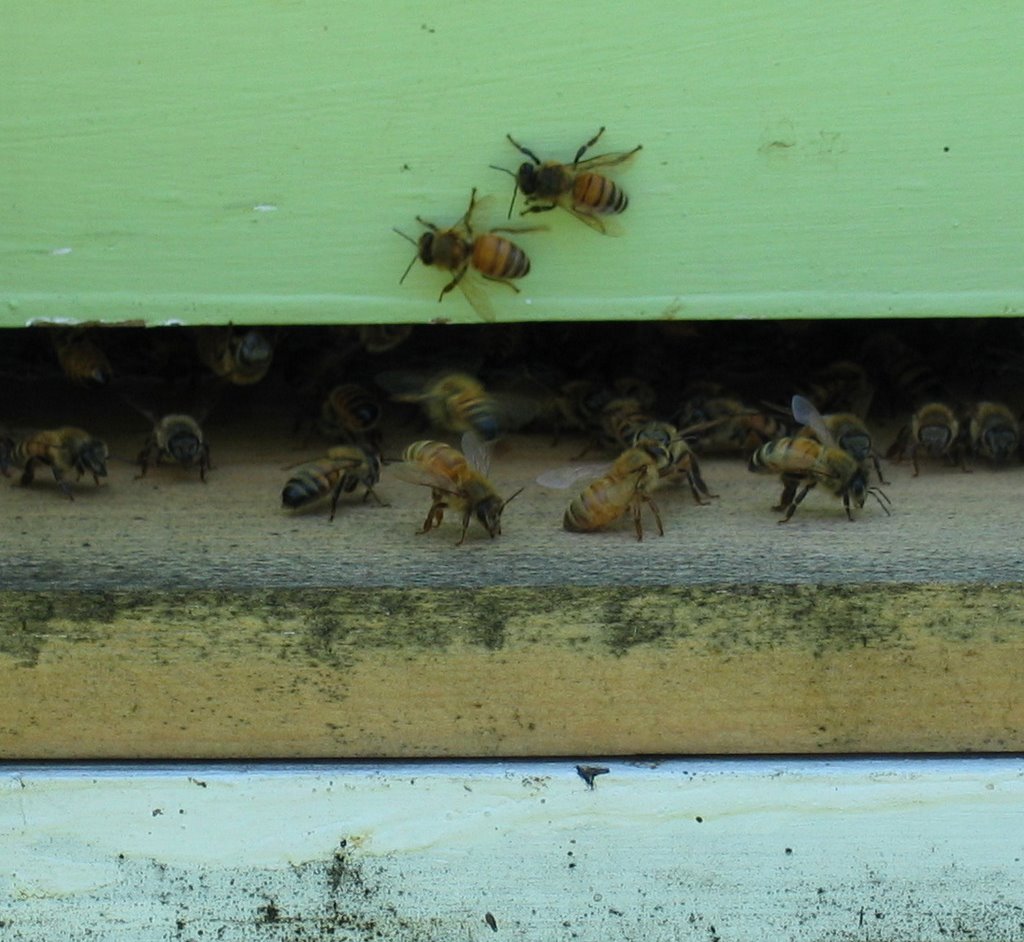 The front door of one of our new hives is a busy place. There are bees fanning, guarding, entering, giving directions, exiting, and just cooling themselves. Sometimes you even catch them house cleaning -- removing dead bees, brood that didn't make it, or other debris.
Today is pretty warm so there are many bees fanning. They do this to keep the hive the proper temperature for brood rearing and to take some of the humidity from the air for honey production. When it gets really hot, they fan to prevent the wax from melting.
We added an onboard waterer to each hive today because the temperatures are predicted to be close to ninety and there is no rain in the forecast for at least ten days. Bees, like all animals, need water. We make it easy to get water because the hive is less stressed that way. Less stress creates healthy colonies that can ward off mites and disease and produce more bees and honey.
Monday, April 10, 2006
Bees!
 Today, I added two new colonies of bees for my just planted orchard. I'm sorry there are no pictures of the action, but I couldn't get the bees installed and take pictures at the same time. I wanted them in the hive as soon as possible. My bee man at McCary Apiary in Buckatunna, has the calmest three banded Italians but he must have miscalculated the shipping time or just forgot what day it was and they arrived this morning which means that they sat around over the weekend in a truck somewhere. There were many dead. This is normal, but I know they are weaker than a colony with single day shipping or no shipping. But, they are already building comb. How exciting!
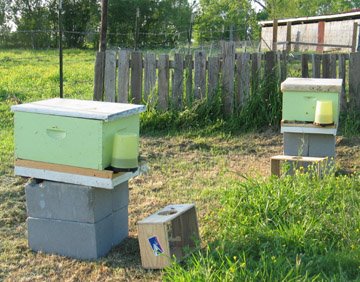
I will attempt to raise these bees organically. Organic bees are few and far between in this part of the country. Mites almost make it impossible. See the unpainted thing between the bottom board and the box. This is a screen. Supposively, the mites will fall through the screen and then not be able to catch a ride back into the hive. In the back of the hive, I can remove a tray so that I can see if there is a problem. Inside the hive is a plastic frame with drone comb spacing. Even though the males are expendable in the colony and most beekeepers try to minimize drone comb, mites like the drone larva. Once this comb is built up, the queen has laid, and the workers have nurtured the larva and mites have congregated, I will take the frame and put it in the freezer. After killing the drones, I will return the frame to the hive and the process will continue. This is high maintenance, but this is Mississippi.
For those who don't love bees let me extol their virtues and the virtues of honey. I will start with honey. Honey is an excellent sweetener. Your body can process it easier than sugar. And if you are allegeric to Spring or Fall you can use locally grown seasonally appropriate honey to alleviate allergy symptoms. Of course, this is not an immediate cure but over time you can eliminate allergy medications for seasonal allergies. Bees do nothing for animal allergies.
Bee stings can help with arthritis symptoms. I know this personally. I severed the tendons and nerves in my thumb (cooking accident) and waited around a week before going to the doctor. Surgery followed and because of the week without connected tendons I had a lot arthritic type symptoms. Before I started beekeeping and getting the occasional sting. I could barely use my thumb. Now, though I cannot hyper-extend, I can use it without pain and I cannot predict rain.
I love the insect and they hold a wonderful place in nature as a healer, feeder, and pollinator. To bad they cannot cut the grass.
Subscribe to:
Posts (Atom)